
Sleep fragmentation is sleep broken again and again by brief arousals through the night, keeping the brain from cycling into its deeper, restorative stages. Non-REM sleep moves through three distinct stages, each defined by measurable brain activity: Stage 1 is the handoff between waking and sleeping, Stage 2 marks true sleep onset, and Stage 3 is deep sleep, also called slow-wave sleep, the stage that does the work of physical restoration. When sleep fragments, a person can lie in bed all night and rarely reach Stage 3, then wake up drained despite plenty of hours logged. Spinal dysfunction feeds this pattern by disrupting the nervous system signaling that governs the shift from an alert state into a restful one. The spine houses and protects the nervous system, the central pathway carrying messages between the brain and the rest of the body, including the automatic functions that regulate sleep-wake transitions. Structural misalignments along that pathway can interfere with the signals the body needs to settle fully into rest, leaving sleep shallow and easily interrupted instead of deep and consolidated. That sets it apart from insomnia, which is trouble falling or staying asleep in the first place. Fragmentation instead describes sleep that looks present on the surface but never reaches its deeper, more restorative stages. Addressing the structural cause, rather than only managing the symptoms it produces, is central to rebuilding proper sleep architecture from the ground up. Correcting the underlying spinal dysfunction supports the nervous system's ability to regulate the transition into deep, restorative sleep stages, rather than masking the daytime fatigue and grogginess that fragmented sleep leaves behind.
What Sleep Architecture Actually Means (And Why Fragmentation Isn't Just Bad Sleep)
Sleep architecture is the term for the structured pattern your brain moves through each night. It is not one long stretch of unconsciousness.
Picture it as a series of cycles, each built from distinct stages the brain moves through in order. Fragmentation is what happens when that cycling gets cut off before it finishes.
| Sleep Stage | What Happens | Where Fragmentation Interrupts It |
|---|---|---|
| Stage 1 | The body begins its transition from wakefulness into sleep, with muscles relaxing and brain activity slowing. | Frequent arousals here keep the body cycling back toward wakefulness before sleep ever truly begins. |
| Stage 2 | True sleep onset occurs, and the brain settles into a steadier, more organized rhythm. | Brief awakenings at this stage reset the cycle, forcing the brain to restart its climb toward deeper sleep. |
| Stage 3 | Deep sleep, also called slow-wave sleep, delivers the physical restoration the body depends on overnight. | This is the stage fragmentation most often blocks entirely, leaving the body running on hours that never reached restorative depth. |
The Stages Your Brain Cycles Through Every Night
Non-REM sleep unfolds across three measurable stages. Stage 1 is the transition between wakefulness and sleep. Stage 2 marks true sleep onset, and Stage 3 is deep sleep, also known as slow-wave sleep.
According to the NIH, non-REM sleep consists of three stages defined by brain activity measurements, with Stage 1 representing the transition between wakefulness and sleep, Stage 2 marking the onset of sleep, and Stage 3 comprising deep sleep or slow-wave sleep — one expert assessment rather than a study finding. That climb through Stage 1, Stage 2, and Stage 3 is what deep, consolidated sleep is supposed to look like. Reaching Stage 3 night after night is what actually restores the body.
Why Fragmented Sleep Feels Like Eight Hours That Never Happened
A person can log eight full hours in bed and still feel like none of it happened. That frustration is common, and it usually points to fragmentation rather than a lack of time asleep.
Fragmented sleep is what happens when brief arousals repeatedly break the night before the brain can settle into Stage 3. The spine's role as the nervous system's central highway matters here. At the neurological path back to deep sleep, that highway image explains why structural signaling, not just time in bed, determines whether deep sleep is ever reached — a connection explored further in Sleep Architecture and Parasympathetic Recovery.
How the Nervous System Decides Whether Your Body Gets to Rest
Every night, the body has to choose between two states. It can stay alert and reactive, or it can settle into recovery.
You don't get a vote in that choice. The autonomic nervous system runs it, and the spine is the highway carrying every signal it sends.
The Two-State Switch Behind Every Night's Sleep
The fight-or-flight state keeps the body scanning for threats, muscles ready, heart rate elevated. The rest-and-digest state does the opposite, slowing the body down so deep sleep can happen.
When spinal dysfunction interferes with that highway, the switch into rest-and-digest can stay incomplete. Sleep still happens, but it stays shallow rather than deep. Insomnia symptoms already reflect how widespread sleep disruption is. According to PubMed Central, insomnia symptoms are present in a significant portion of the US general population, with prevalence estimates ranging from 17.4% to 36.3% over a 1-year or 1-month period. That range describes people who struggle to fall or stay asleep, not the fragmentation pattern this article addresses, but it shows how common disrupted sleep already is. Fragmentation and insomnia are different problems, and understanding Sleep and Deep Recovery Cycles helps separate the two.
Why Chasing Symptoms Leaves the Real Signal Problem Untouched
Most sleep advice stops at the symptoms. Cut the caffeine, dim the lights, manage the stress. All reasonable, and none of it touches the spine.
About the usual fixes: they chase stress and poor sleep hygiene while a real root cause sits untouched — the physical structure of the spine. At Touch of Wellness Chiropractic, that structural piece is the missing half of the whole conversation.
Where the Sleep-Hygiene Approach Runs Out of Road
Sleep hygiene assumes the signaling pathway between brain and body is already clear. When spinal dysfunction is rerouting or blocking those signals, better habits alone cannot finish the job.
Pain often gets blamed for restless nights, but among patients referred to a sleep center, polysomnography measures of sleep fragmentation and nocturnal oxygen desaturation were not found to be related to pain intensity. The journal Pain Medicine documents that polysomnography measures of sleep fragmentation and nocturnal oxygen desaturation were not found to be related to pain intensity in one study.
That disconnect matters. It points straight back to the nervous system signaling this article keeps returning to, a thread carried further in Rate Variability and Sleep Restoration.
How a Structural Signal Problem Shows Up in the Research Record

The research on the spine-sleep connection doesn't hand you one clean verdict. Some findings back the structural argument. Others complicate it — and those complications matter every bit as much as the support does.
| Study Focus | Population Measured | Reported Finding |
|---|---|---|
| Sleep fragmentation and pain correlation | Patients referred to sleep center | Sleep fragmentation and nocturnal oxygen desaturation were not found to be related to pain intensity |
| Spinal manipulative therapy vs wait-list control | Chronic musculoskeletal pain with occipito-atlantal joint dysfunction | Anxiety and insomnia showed no significant improvements compared to a wait-list control group |
| Insomnia symptom prevalence | US general population, 1-year or 1-month prevalence | Prevalence estimates ranging from 17.4% to 36.3% |
What the Data Does and Doesn't Show About Manual Therapy and Sleep
Take one study on chronic musculoskeletal pain tied to occipito-atlantal joint dysfunction. Anxiety and insomnia showed no significant improvement in that group against a wait-list control. Published research data documents that anxiety and insomnia showed no significant improvements in participants receiving spinal manipulative therapy compared to a wait-list control group.
That result does not disprove the structural connection. It shows the connection is specific rather than universal, tied to which segments and signals are actually involved. Learning more about what chiropractic treatment involves helps clarify where that connection applies.
Mapping the Spine's Role in Nervous System Signaling
So how does this actually work, down in the spine itself? The nervous system runs through and alongside the vertebral column at every level, branching out to organs, muscles, and glands. Each vertebral segment either shields that signaling pathway or, when it drifts out of place, presses on it.
How Restricted Segments Interrupt the Signal Path
A restricted segment can crowd the nerve pathways that handle autonomic regulation. Compress or irritate those pathways, and the signal telling the body to shift into rest-and-digest mode shows up late, weak, or half-finished. So the body stays partly braced for alertness instead of settling all the way into deep sleep.
How an Assessment Traces a Sleep Complaint Back to a Spinal Finding
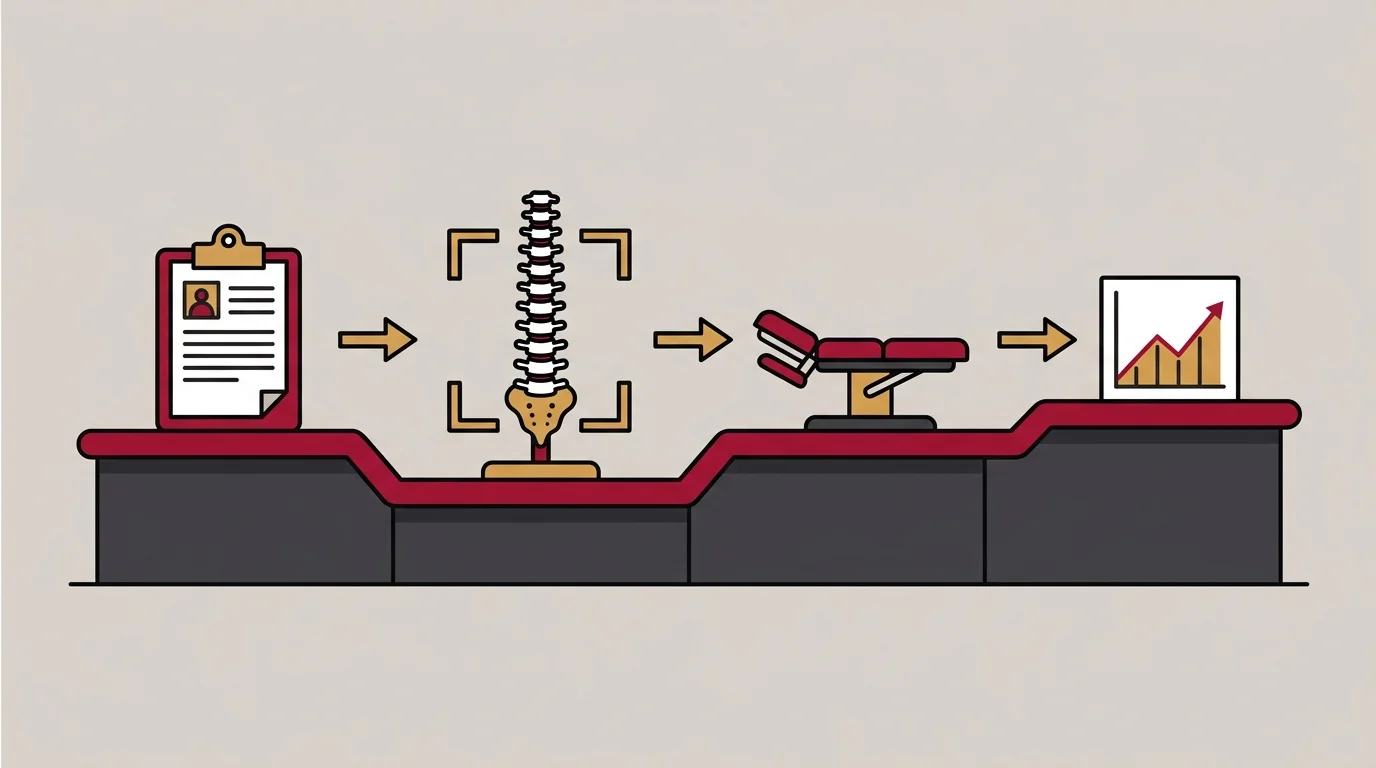
Knowing the mechanism is one thing. Tracing it back to a specific finding is another.
| Assessment Step | What Is Being Evaluated | What It Confirms or Rules Out |
|---|---|---|
| Intake and History | The patient's own description of the sleep complaint, including how long it has persisted and how it feels night to night | Whether the pattern points toward fragmentation, insomnia, or another disruption entirely |
| Structural Spinal Exam | Alignment and motion segment by segment along the spine, checking for restrictions along the nervous system's central highway | Whether a specific segment shows the kind of restriction capable of interfering with autonomic signaling |
| Neurological Correlation | Whether the location of any structural finding lines up with the pathways known to regulate the shift into rest-and-digest mode | Whether the reported sleep disruption can be reasonably connected to a spinal finding rather than an unrelated cause |
| Care Plan Development | How the confirmed finding should be addressed, and what pace of Chiropractic adjustment fits the case | That the plan targets the structural cause rather than only the surface-level fatigue it produces |
The Order an Assessment Follows From Intake to Finding
An assessment starts with the sleep complaint itself, in the patient's own words. From there it moves into a structural exam, checking spinal alignment and motion segment by segment. Only after that sequence does a specific finding connect to the reported disruption.
Frequently Asked Questions
Once the spine-sleep connection clicks, the same questions come up again and again. Here are the straight answers.
Can a chiropractor actually help with sleep problems, or is it just for back pain?
Chiropractic care isn't only about back pain. If a restricted spinal segment is interfering with the nervous system signaling that governs rest-and-digest mode, addressing that structure can support deeper, more consolidated sleep.
How long does it take to see sleep improvements after starting chiropractic care?
Every case is different because every spine is different. Improvement tends to follow once the signaling pathway is clear enough for the body to settle fully into deep sleep stages.
What's the difference between sleep fragmentation and insomnia?
Insomnia means trouble falling or staying asleep in the first place. Fragmentation is different — sleep looks present on the surface but keeps breaking before it reaches Stage 3.
Can stress alone cause sleep fragmentation without a spinal issue?
Stress alone can absolutely disrupt sleep. But it isn't the only mechanism — structural interference along the spine can produce that same shallow, easily broken pattern even when stress is well managed.
Is it possible to have fragmented sleep and not remember waking up during the night?
Yes. Brief arousals that break the sleep cycle often happen without full waking, which is why someone can feel exhausted after a full night in bed and have no memory of the disruption.
Rebuilding Sleep Architecture From the Foundation Up
The spine is the nervous system's central highway, and that highway either carries the signal for rest or it doesn't. Fragmentation is what happens when that signal gets rerouted before it ever reaches its destination and the night can settle into deep sleep.
Correcting the structural cause isn't about masking symptoms with one more habit change. It's about clearing the pathway so the body can finally complete the shift into deep, consolidated sleep. That's the foundation this whole article has pointed toward.
Getting back to being you starts with finding out whether a restricted segment is the reason your nights never reach Stage 3. Schedule a structural sleep assessment with Touch of Wellness Chiropractic.