
(309) 321-8412 | 1101 W Jackson St, Suite A, Morton, IL 61550
(309) 321-8412 | 1101 W Jackson St, Suite A, Morton, IL 61550
Why Is My Dog Bunny-Hopping? Recognizing Subtle Signs of Canine Spinal Misalignment
Bunny-hopping in dogs is a nervous system signal. It is not a quirky gait — it is the body reporting that something in the communication chain between the spine and the hind legs has broken down.
The most commonly identified cause is hip dysplasia, a skeletal condition where joint laxity and abnormal remodeling force a dog to move both hind legs as a single unit instead of alternating them. It appears most often in large breeds and tends to surface during the rapid growth phase between 4 and 12 months of age.
But hip dysplasia is not the only explanation. It is not always even the primary one.
Spinal disorders — particularly degenerative lumbosacral stenosis — compress the nerve roots in the lower spine and produce pelvic limb weakness that changes how a dog moves. The hind legs are not the problem. They are the output of a nervous system that is not receiving clean signals from above.
That distinction is everything. A dog compensating for spinal pain does not always yelp or refuse to move. It redistributes force across its limbs, subtly altering its entire biomechanical pattern. It may hold its back rigid and struggle to rise. It may bunny-hop without ever appearing to be in obvious distress.
Bunny-hopping can indicate hip joint disease, spinal nerve compression, or both — and the two conditions require different approaches. Treating the hips when the spine is the primary driver will not resolve the underlying dysfunction.
Manual spinal mobilization has demonstrated the ability to reduce pain and restore normal movement ranges in dogs experiencing biomechanical dysfunction. Addressing the spinal component is not an alternative to veterinary diagnosis. It is a missing piece most standard workups do not include.
The hind legs do what the spine tells them to. That is where any honest assessment has to start.
Last Updated: August 18, 2026
- • What Bunny-Hopping Actually Tells You About Your Dog's Body
- • Why Most Practitioners Get the Bunny-Hop Diagnosis Wrong
- • The Spinal Conditions That Produce a Bunny-Hop Gait
- • How a Dog's Whole Body Compensates for Spinal Dysfunction
- • What to Look For Beyond the Hop: The Full Symptom Picture
-
• Frequently Asked Questions
- • What exactly is canine bunny-hopping and what does it look like?
- • Can a spinal misalignment cause a dog to bunny-hop, or is it always hip dysplasia?
- • How does an animal chiropractor diagnose spinal misalignment in a dog?
- • Is animal chiropractic care safe for older dogs showing gait changes?
- • What are the risks of masking my dog's bunny-hopping with long-term pain medications?
- • The Nervous System Is Running the Show — Not Just the Hips
What Bunny-Hopping Actually Tells You About Your Dog's Body
Bunny-hopping is exactly what it sounds like. Both hind legs swing forward together instead of alternating — a synchronized hop where there should be a stride. Most owners catch it on stairs or during a run and write it off as quirky.
That's not quirky. That's your dog telling you something is wrong.
The hind legs are the output. They're the visible end of a chain that starts somewhere further up in the body. When that chain gets disrupted, the legs find whatever movement pattern hurts least — and they stay there.
Hip dysplasia is the first place most people land — and it's a real cause, especially in large breeds. But the gait pattern doesn't tell you which system is failing. It only tells you something is. That distinction is exactly where most owners get stuck, and where the standard diagnostic shortcut does real damage.
The Biomechanics Behind the Gait
Here's what's actually happening. A dog moving normally distributes load evenly across all four limbs — each hind leg pushing off independently. Joint laxity, nerve compression, or spinal restriction breaks that pattern. The nervous system reroutes movement to protect whatever's compromised.
It isn't a decision. It's a reflex. The body finds the path of least pain and locks in.
And this isn't guesswork. Dogs experiencing spinal pain redistribute ground reaction forces away from affected limbs and toward healthier ones — a biomechanically precise compensation that keeps the animal moving while the underlying dysfunction goes unaddressed.
The legs aren't broken. They're doing exactly what the spine told them to do.
That workaround has a cost.
The more a dog relies on abnormal force distribution, the more strain accumulates in structures that weren't designed to carry that load. The gait doesn't just reflect the problem. It accelerates it.
Why the Cookie-Cutter Hip Dysplasia Assumption Falls Short
The default assumption is hip dysplasia. That's understandable — it's one of the most common skeletal diseases in dogs, particularly in large breeds, and it does produce bunny-hopping. But common doesn't mean only. And it doesn't mean the hips are always the primary driver.
Spinal misalignments — especially in the lumbosacral region — compress the nerve roots that control the pelvic limbs. From the outside, it looks identical to hip dysplasia. A workup that evaluates the hip joint and stops there never finds the spinal source.
The dog gets managed for the wrong problem. Where animal chiropractic care fits into the picture depends entirely on what the actual source is — which is exactly why a complete assessment matters more than a fast label.
A dog whose hip x-rays look clean but whose gait keeps deteriorating isn't a mystery. It's a dog whose spine hasn't been examined yet.
Owners who want to pursue that path often ask whether care from an AVCA-certified practitioner is safe — and that's exactly the right question to ask before anything else. The hind legs do what the spine tells them to. That's where the real diagnostic work starts.
| Gait Pattern | What It Looks Like | What It Signals Structurally | Where to Look First |
|---|---|---|---|
| Synchronized hind-leg hop (classic bunny-hop) | Both hind legs push off and land together instead of alternating during running or stair climbing | Joint laxity, pelvic limb weakness, or nerve root compression reducing independent limb control | Hip joint structure and lumbosacral spine — both must be assessed before a cause is assigned |
| Rigid, hunched back posture while moving | Dog carries its spine in a fixed, guarded position rather than flexing naturally through the gait cycle | Spinal restriction or nerve root irritation causing the dog to brace against movement-generated pain | Thoracolumbar and lumbosacral spinal segments — postural guarding often indicates spinal origin, not hip origin |
| Reluctance to rise from rest | Dog hesitates or staggers when transitioning from lying down to standing, especially after prolonged rest | Stiffness from inflammation, joint remodeling, or spinal nerve compression that worsens with inactivity | Hip joints and lower spine — morning stiffness that eases with movement points toward structural restriction, not muscle weakness alone |
| Asymmetric weight shift during standing | Dog consistently favors one side, offloads one hind limb, or stands with hind feet abnormally close together | Compensatory force redistribution — the nervous system actively rerouting load away from the compromised area | Spinal alignment and pelvic symmetry — asymmetric loading patterns frequently originate above the hip joint |
| Reluctance to jump or use stairs | Dog avoids activities requiring full hind-limb extension or axial spinal loading | Pain or neurological inhibition during movements that load the lumbosacral junction or hip joint under full extension | Lumbosacral region — avoidance of extension-loaded movement is a hallmark sign of cauda equina involvement |
| Normal x-rays but persistent gait changes | Hip radiographs appear unremarkable, yet gait abnormality or bunny-hopping continues or worsens | Soft-tissue spinal dysfunction or subluxation not captured by standard radiographic imaging | Spinal column and neurological function — this pattern signals the hip was not the primary driver and the spine has not yet been examined |
Why Most Practitioners Get the Bunny-Hop Diagnosis Wrong
Here's the standard workup. Observe the gait. Evaluate the hips. Confirm dysplasia or rule it out. Build a management protocol around whatever was found.
Reasonable sequence. Incomplete one.
The problem isn't that hip dysplasia gets examined. The problem is that the exam stops there.
When the spine doesn't get evaluated, an entire category of dysfunction stays invisible. The dog gets treated for whatever was found — not necessarily for what's actually driving the movement pattern.
That's how you end up with years of symptom management and no structural change.
The hind legs keep hopping. The treatment keeps targeting the hind legs. The control panel — the spine and the nervous system feeding it — never enters the conversation.
The Protocol That Treats the Symptom and Ignores the System
Hip dysplasia is one of the most common skeletal diseases in dogs — especially in large breeds. That frequency is exactly what makes it dangerous as a default assumption.
See something often enough and it starts to feel like the answer before the question is finished. The clinical pattern feels familiar. The workup compresses. The exam ends where the assumption got confirmed.
That's not diagnostic rigor. That's pattern repetition.
Bunny-hopping is a movement output. It doesn't tell you which system is failing. It tells you something is.
Hip dysplasia can produce it. Lumbosacral nerve compression can produce it. Spinal restriction that alters how the nervous system signals the pelvic limbs can produce it. When the workup confirms one possibility and stops, the others don't disappear.
They just don't get treated.
Spinal mobilization has demonstrated the ability to reduce pain and restore normal kinematic ranges in dogs experiencing biomechanical dysfunction, according to NIH-indexed research.
That's not a fringe position. It's evidence that the spinal component of these presentations is real and addressable.
And it gets overlooked every time the protocol locks onto the hip and stops.
A dog is a biological system. The hind legs are downstream of the spine. The spine is downstream of the nervous system driving the whole structure.
Treat the symptom without examining the system producing it and you're managing the output of a broken signal.
The signal keeps running.
Who This Pharmaceutical-First Approach Actually Hurts
Dogs that end up on indefinite pharmaceutical protocols are usually the ones whose workup stopped at the hip.
They get a diagnosis. They get managed. Management becomes the plan — no defined endpoint, no reassessment trigger. The hidden risks of long-term NSAID use for arthritic dogs are real and they accumulate. But that conversation rarely happens when the primary goal is keeping the symptom quiet.
Pain masking doesn't restore the ground reaction force distribution that's compromised when the spine is dysfunctional. It doesn't address the nerve root compression altering pelvic limb function.
It keeps the dog comfortable enough to keep moving. And while it does, the structural problem compounds.
That's not a treatment plan. That's delay with side effects.
The owners most affected by this did everything right. They went to the vet. They got the x-rays. They followed the protocol.
Six months later, the gait is still getting worse.
That's not a mystery. That's a dog whose spine was never part of the conversation.
| Conventional Approach | What It Targets | What It Misses | Clinical Consequence |
|---|---|---|---|
| Observe bunny-hopping gait, refer for hip x-rays | Hip joint structure and degree of joint laxity | Spinal nerve root compression that produces identical gait patterns | Dog receives a hip diagnosis when the primary driver is lumbosacral in origin |
| Confirm or rule out hip dysplasia and close the workup | One joint, one system, one diagnosis | The spine and nervous system feeding the pelvic limbs downstream | Spinal misalignment goes undetected; the underlying signal dysfunction continues |
| Prescribe long-term pharmaceutical pain management | Symptom suppression — reducing observable discomfort | The structural root cause altering how the nervous system controls hind limb movement | Dog remains mobile but the biomechanical compensation pattern keeps compounding |
| Rely on the most statistically common diagnosis as the default assumption | Frequency-based pattern recognition — hip dysplasia is common, so it leads | Less common but equally real spinal sources that produce the same gait output | Diagnostic process compresses prematurely; alternative causes aren't ruled out |
| Monitor gait changes and adjust medication dosage over time | Symptom progression as the primary clinical indicator | Kinetic force distribution changes and early spinal dysfunction before symptoms escalate | Structural deterioration advances while management stays focused on comfort |
| Exclude spinal assessment from the standard bunny-hop workup | Joint-level evaluation only — hips, sometimes knees | The control panel: spinal mechanics and nervous system signaling to the pelvic limbs | Dogs whose spine is the primary driver never receive structurally appropriate care |
The Spinal Conditions That Produce a Bunny-Hop Gait
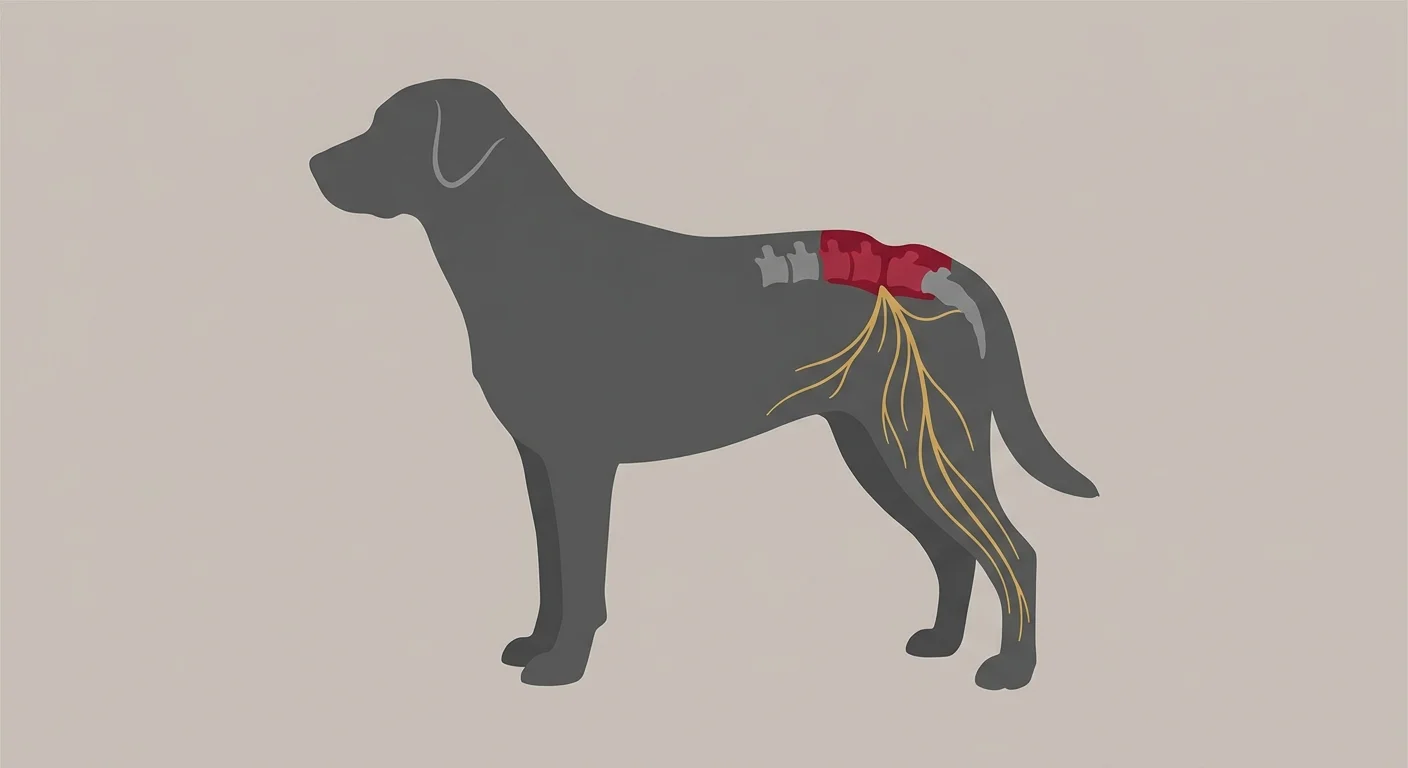
The hip gets all the attention. The spine gets ignored.
That's the gap. And it's where dogs end up on indefinite management plans that never touch the actual problem.
Two spinal conditions produce gait changes that look identical to hip-driven bunny-hopping from the outside: degenerative lumbosacral stenosis and spinal subluxation patterns that disrupt the neurological signals running the hind limbs.
Both are real. Both are addressable. And both get missed when the diagnostic workup stops at the hip.
Here's the systems frame. The hind legs are downstream — they execute what the spine and nervous system tell them to.
Treating the gait without examining the signal producing it isn't a diagnosis. It's a guess.
Degenerative Lumbosacral Stenosis and Nerve Root Compression
Degenerative lumbosacral stenosis compresses the cauda equina — the nerve bundle at the base of the spine that runs the pelvic limbs.
When those nerve roots get compressed, the signals traveling to the hind legs break down. The limbs respond with weakness, altered movement, and exactly the synchronized hopping pattern owners are searching the internet for at midnight.
The output looks like a hip problem. The source is the spine.
Here's what makes this easy to miss: the dog doesn't always look like it's in pain. According to NIH-reviewed findings, compression of lower spinal nerve roots causes compensatory movement patterns and structural spinal pain — but that pain doesn't always surface as crying or refusing to move.
It surfaces as a gait that's subtly, persistently wrong.
That's the version that gets chalked up to personality — or age — and goes unexamined for months.
The signs are there if you're looking at the right things: back held rigid, struggling to rise from rest, asymmetric movement through the hips and pelvis.
Those aren't unrelated quirks. That's the nervous system redistributing load away from the compressed area.
Understanding what a canine chiropractic exam process actually evaluates helps owners see why a hip x-ray alone can't rule this out — because it's not looking at the right structure.
Spinal Subluxations and Altered Neurological Communication
Spinal subluxations work differently. They don't compress nerve roots the way lumbosacral stenosis does — but they corrupt the quality of the neurological signal passing through the affected segment.
The spine isn't just a structural column. It's the conduit the nervous system uses to coordinate movement through the entire body.
Misalign a vertebral segment, and that coordination breaks down downstream.
When a subluxation alters that signal, the muscles and limbs controlled by the affected nerve pathways don't receive clean instructions.
Published clinical analysis confirms that rigidity, reluctant movement, and asymmetric gait patterns indicate underlying neurological or spinal root compromise — the kind that doesn't appear on a standard orthopedic exam targeting only the hip joint.
The exam misses it. Not because the problem isn't there. Because the exam isn't looking there.
The hind legs do what the spine tells them to.
A subluxation three vertebrae up from the pelvis can produce a gait change that looks exactly like hip disease. When the control panel isn't examined, managing the output doesn't change what the signal is doing.
It just delays the conversation that was needed from the start.
| Condition | Region Affected | Primary Gait Sign | Distinguishing Feature | Assessment Starting Point |
|---|---|---|---|---|
| Hip Dysplasia | Hip joint (ball-and-socket) | Synchronized rear-leg hopping, especially at a trot | Joint laxity confirmed on orthopedic x-ray; worsens with joint loading | Hip and pelvis imaging plus hands-on joint palpation |
| Degenerative Lumbosacral Stenosis (DLSS) | Lumbosacral junction (base of spine) | Pelvic limb weakness, reluctance to jump or climb stairs, bunny-hop pattern | Pain on deep palpation over the lumbosacral junction; may not cry out but avoids extension | Spinal assessment focused on the lower lumbar and sacral segments |
| Spinal Subluxation Pattern | Any vertebral segment from lumbar to sacral | Asymmetric hind-limb movement, stiffness on one side, inconsistent gait quality | Hip x-rays appear unremarkable; gait deficit persists or progresses without hip-targeted treatment | Segmental spinal motion analysis across the full vertebral column |
| Cauda Equina Nerve Compression | Nerve roots exiting the lower lumbar spine | Dragging or scuffing of rear paws, reluctance to rise, altered tail carriage | Neurological signs in pelvic limbs without clear orthopedic joint pathology | Neurological screen combined with lower spinal palpation and motion assessment |
| Thoracolumbar Spinal Restriction | Mid-to-lower thoracic and upper lumbar region | Shortened rear stride, hunched posture while moving, reluctance to flex the back | Gait change concentrated in stride length rather than synchronized limb coupling | Full spinal assessment from thoracic junction through the pelvis |
| Combined Hip-and-Spine Presentation | Hip joint plus one or more spinal segments | Bunny-hop with additional postural rigidity, uneven weight-shifting between limbs | Partial response to hip-targeted treatment with persistent gait asymmetry | Coordinated orthopedic and spinal evaluation to isolate each contributing source |
How a Dog's Whole Body Compensates for Spinal Dysfunction
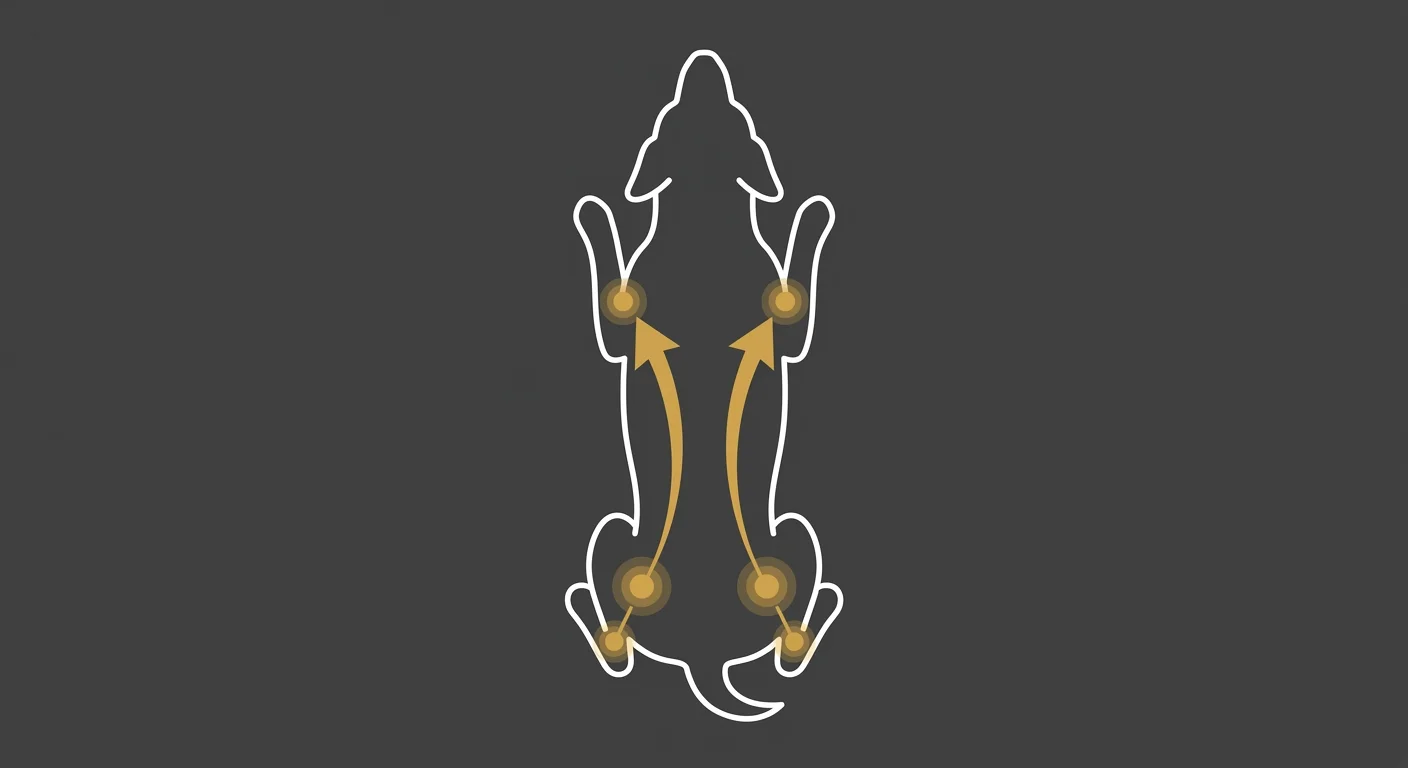
The spine doesn't hurt in isolation. When something's compromised up there, the whole body reorganizes around it — and that reorganization shows up in places you'd never think to look.
Kinetic gait analysis backs this up. Dogs compensating for spinal pain redistribute ground reaction forces across all four limbs — loading the healthy ones harder, sparing the compromised ones. What reads as a hind-end problem is a whole-body negotiation. The body is quietly moving stress away from the source and depositing it somewhere else.
That's why you can't evaluate a bunny-hopping dog by watching the hind legs alone. The compensation isn't contained to the symptom. It spreads into the neck, the shoulders, the forelimbs, the way the dog rises in the morning. The whole system is adapting to protect the point of dysfunction.
Ground Reaction Force Shifts and What They Reveal
Ground reaction force shifts aren't random. They're the body's precision response to pain it can't resolve. When a spinal segment is restricted or compressed, the nervous system routes around it. The limbs closest to the dysfunction bear less load. The limbs farthest away bear more.
That redistribution is measurable and consistent. It's not the body breaking down — it's the body doing exactly what it was designed to do: protect the compromised area by adjusting the load map. But that's a short-term fix. Long-term, it creates structural strain in the limbs carrying the extra weight.
That's where mobility progress measurements after a spinal adjustment become the real test. Without a baseline and follow-up markers, there's no way to know whether structural function is genuinely being restored — or whether the dog is just getting better at compensating. Those two outcomes look similar from the outside. They aren't the same thing.
Secondary Strain Patterns That Develop Over Time
Compensation doesn't stay local. It migrates.
When the hind end offloads, the forelimbs take the difference. Neck posture shifts to balance a body that's no longer moving symmetrically. Muscles along the spine lock into rigid, protective patterns. Texas A&M veterinary researchers identify a hunched back and reluctant movement as clear indicators of neurological or spinal root compression — not personality changes, not the dog slowing down with age.
The dog that struggles to rise in the morning, holds its neck rigid, and bunny-hops through the yard isn't showing three separate problems. It's showing one problem — a disrupted control panel — expressing itself across every system it runs. Manual spinal mobilization addresses that control panel directly. Clinical evidence shows it can significantly restore kinematic range and pelvic limb function in dogs with exactly this pattern. Managing the downstream outputs without correcting the upstream signal keeps the dog moving. It doesn't change what the nervous system is sending.
| Compensation Pattern | Body Region Affected | Observable Sign | What It Indicates Structurally |
|---|---|---|---|
| Hind limb ground force offloading | Pelvic limbs and hind quarters | Bunny-hopping gait, synchronized rear leg movement, reluctance to bear weight on one side | Spinal segment restriction or nerve root compression forcing the body to redistribute load away from the dysfunction |
| Forelimb overloading | Shoulders, elbows, and front legs | Increased muscle mass or tension in the forelimbs, stumbling on front legs, early forelimb fatigue | The forelimbs compensating for reduced hind-end load capacity, absorbing structural stress the rear can no longer manage |
| Cervical postural shift | Neck and upper spine | Head held low or rigid, reluctance to turn the neck, stiffness when looking side to side | The neck repositioning to rebalance a body that is no longer moving symmetrically through the hind quarters |
| Paraspinal muscle guarding | Muscles along the length of the spine | Visible or palpable rigidity along the back, hunched posture, sensitivity to touch along the spine | Protective muscular contraction around a compromised spinal segment, the body's attempt to immobilize and shield the dysfunction |
| Difficulty rising from rest | Lumbar spine, sacroiliac junction, and pelvic girdle | Slow, effortful movement from lying to standing, shifting weight to avoid one region | Neurological or structural compression making the transition from rest to load-bearing painful or mechanically restricted |
| Asymmetric hip and pelvic movement | Pelvis, sacrum, and lumbar vertebrae | One hip appearing higher than the other during movement, uneven stride length, visible tilt in the topline | Unilateral spinal restriction creating unequal muscle activation and altered pelvic mechanics through the stride cycle |
What to Look For Beyond the Hop: The Full Symptom Picture
The bunny-hop doesn't arrive alone. It brings company.
The hop is the symptom that gets noticed. It's rarely the first thing that happened.
By the time a dog is visibly altering its gait, the nervous system has already been compensating for some time. And that compensation leaves tracks.
Most owners who look past the hop find a cluster of changes they'd written off as aging, stubbornness, or a string of unrelated bad days.
But they're not unrelated. They're the same control panel problem — expressing itself through every system it governs.
Postural and Behavioral Changes That Precede the Obvious Gait Shift
A dog with underlying spinal compromise doesn't wake up one day bunny-hopping. The behavioral shifts come first.
Reluctance to jump onto the couch. Hesitation at the base of the stairs. A stiffness when rising from rest that wasn't there six months ago. These aren't new problems. They're the same problem in an earlier stage.
Posture is another early signal most owners miss.
Holding the neck rigid. Carrying the back in a slightly hunched position. Standing with the pelvis tucked under. These aren't random quirks. They're the body protecting a compromised spinal segment — recruiting surrounding musculature to stabilize what the vertebrae can't.
Age of onset matters — and it changes what you're looking at.
A dog that first shows these signs during the rapid growth phase between 4 and 12 months is presenting a different clinical picture than one that develops them at seven years old. Early developmental gait changes point toward a different upstream cause than the gradual structural shifts in a mature dog. Both deserve an exam that includes the spine. Neither gets that by default.
Bringing a Complete Clinical Picture to the Assessment
When owners bring a dog in for a gait concern, the most useful thing they can bring with it is a complete observation history.
Not just "he bunny-hops sometimes." When did it start? What changed before it? Is it worse after rest or after activity? The fuller that picture, the more the assessment can target the actual source — not just the output that finally got noticed.
Notice when the stiffness is worst — after rest, after activity, or first thing in the morning. Notice whether the dog favors one side when turning. Notice whether the reluctance to rise appeared before the gait change or after it.
That sequencing tells a story a snapshot exam can't capture. It's the difference between guessing at the cause and having a clinical trail to follow.
That's the difference between a single complaint and a clinical picture. The canine chiropractic exam process is built to work with that full picture — palpating the entire spinal column, not just the hip.
A dog whose owner walks in with a timeline of behavioral and postural changes gets a more precise assessment than one described only by the gait.
The hop is where the conversation starts. The spine is where it needs to go.
| Observable Sign | When It Typically Appears | Body System Involved | What to Report at Assessment |
|---|---|---|---|
| Bunny-hopping gait | Often visible once compensation is already established | Hind limb locomotion / spinal motor output | When it started, whether it's constant or intermittent, and whether it worsens after rest or activity |
| Reluctance to rise from resting position | Frequently appears before gait changes become obvious | Spinal nerve pathways / pelvic stabilizers | Whether stiffness is worst in the morning, after naps, or after exercise — and how long it takes the dog to loosen up |
| Rigid or hunched back posture | Early to mid-stage compensatory phase | Paraspinal musculature / spinal column | Which part of the spine appears guarded, how consistently the posture occurs, and whether the dog resists being touched along the back |
| Neck held stiff or carried low | Appears as forelimb compensation increases | Cervical spine / neck musculature | Direction the dog avoids turning, whether the stiffness is worse on one side, and any reluctance to look upward or downward |
| Hesitation before jumping or climbing stairs | Often precedes visible gait changes by weeks or months | Hind limb loading / lumbosacral region | Specific obstacles the dog now avoids, how recently the hesitation began, and whether it's progressive or situational |
| Asymmetric movement or favoring one side | Can appear at any stage — early or established | Whole-body load distribution / spinal biomechanics | Which side is favored during turns, whether the dog circles one direction more naturally, and any visible muscle asymmetry along the spine or hindquarters |
Frequently Asked Questions
Once owners realize the bunny-hop might not be a hip problem, the questions get sharper. They stop asking what's wrong with the back legs and start asking what else could be driving this — and what an honest assessment actually looks like.
Here are the questions that come up most. Answered directly — without the pharmaceutical-first framing that shuts the conversation down before anyone looks at the spine.
What exactly is canine bunny-hopping and what does it look like?
Both hind legs swing forward at the same time instead of alternating. Left-right-left-right becomes a synchronized bilateral push-off — the way a rabbit moves, not the way a dog is built to move.
It's most visible at a trot or run. And it often looks almost rhythmic, which is exactly why owners write it off. The motion can seem graceful. Purposeful, even.
But it's a compensation. The dog has found a movement pattern that reduces load on something painful or restricted. That bilateral push-off is the workaround — not a quirk, not a breed trait. The body telling you something isn't right upstream.
Can a spinal misalignment cause a dog to bunny-hop, or is it always hip dysplasia?
Not always. That assumption is exactly what causes the spinal source to get missed.
Degenerative lumbosacral stenosis compresses the nerve roots at the base of the spine and produces pelvic limb weakness and altered movement patterns that look identical to hip-driven gait changes from the outside. The hind legs are responding to a disrupted signal from the spine — not a structural failure at the joint.
Kinetic gait analysis confirms that dogs with spinal pain redistribute ground reaction forces across all four limbs — changing how every leg moves, including the hind end. The bunny-hop can originate upstream. An assessment that only examines the hip won't find it.
How does an animal chiropractor diagnose spinal misalignment in a dog?
The assessment starts at the full spinal column — not just the segment nearest the hip.
Palpation identifies restricted or hypersensitive vertebral segments, asymmetries in muscle tone, and the dog's pain responses at specific points along the spine. Movement gets read too — how the dog rises, how it turns, whether it favors one side, whether the neck is held rigid or the back carried in a hunched position.
Those aren't separate observations. They're one clinical picture. A dog that's reluctant to rise, holds its neck stiff, and bunny-hops isn't presenting three complaints — it's showing one control panel problem expressing itself across connected systems. The assessment traces that signal back to where it starts.
Is animal chiropractic care safe for older dogs showing gait changes?
Age isn't a contraindication. In older dogs with gait changes, the assessment is often where the clinical picture finally gets complete.
Manual spinal mobilization has clinical evidence behind it — it can restore kinematic range and pelvic limb function in dogs with biomechanical dysfunction. And the technique adapts to the individual animal: what palpation reveals, how the dog presents, what it tolerates comfortably.
An older dog with compensatory patterns that have been building for years deserves an exam that includes the spine. What it doesn't need is the assumption that slow decline is just aging.
What are the risks of masking my dog's bunny-hopping with long-term pain medications?
Here's the core risk: managing the output doesn't change the signal.
If the bunny-hop is driven by spinal nerve compression — the cauda equina compression that occurs with degenerative lumbosacral stenosis, for example — masking pain with long-term medications reduces the dog's behavioral response to dysfunction without touching the structural cause. The dog moves more freely. Appears more comfortable. And the underlying spinal compromise keeps progressing.
The compensatory force redistribution across all four limbs persists too — quietly loading joints and soft tissue that weren't built to carry redirected stress. Pain management has a place. But using it as the only intervention, without examining what's generating the pain, means the structural picture keeps progressing while the clinical picture looks like it's improving. Those are two very different things.
The Nervous System Is Running the Show — Not Just the Hips
The bunny-hop isn't a hip problem. It's a readout from a system that isn't coordinating correctly.
The hind legs are the output. The spine and nervous system are the source code.
Managing the output doesn't rewrite the source.
That's the logic pharmaceutical-only protocols skip entirely.
When a spinal segment gets restricted, the body reorganizes around it. The gait changes. Posture shifts. The dog compensates quietly — sometimes for weeks — before the hop becomes obvious enough to catch.
By that point, the nervous system has already been rerouting. Treating the hip without examining the spine means treating the last stop on the signal chain. The source of the disruption stays untouched. The compensation eases. The dysfunction underneath doesn't.
That distinction is what determines what actually changes.
At Touch of Wellness Chiropractic, Dr. Karen Hannah's zoology-grounded approach starts with the spine — because that's where the body's coordination originates. Not the hip. Not the gait. The system producing both.
The hips get all the attention. The spine runs the show. And until that control panel gets a real assessment, you don't actually know what you're treating.
The hind legs do what the spine tells them to.
The hind legs do what the spine tells them to. If no one's looked at the spine yet, you don't have an answer — you have a managed symptom. Find out what's actually driving it.
Copyright Touch of Wellness Chiropractic 2026
1101 W Jackson St, Suite A Morton, IL 61550
Web Design by iTech Valet