
(309) 321-8412 | 1101 W Jackson St, Suite A, Morton, IL 61550
(309) 321-8412 | 1101 W Jackson St, Suite A, Morton, IL 61550
How to Measure Your Pet's Mobility Progress After an Animal Chiropractic Adjustment
Measuring a pet's mobility progress after an Animal Chiropractic adjustment means tracking specific physical markers — not general impressions. The markers that matter are limb weight-bearing symmetry, stride length, and joint extension during movement. Biomechanical research confirms that chiropractic adjustments produce verifiable increases in segmental vertebral mobility and reduce localized muscle splinting in canine spinal segments. These changes are real. But they're only visible to an owner who knows what to look for.
Force-plate research documents that limb weight-bearing symmetry increases significantly within 7 to 10 days following a physical adjustment. That's the primary observation window. Watch for a dog that stops favoring one limb, stops shifting posture to compensate, or starts loading a paw more fully during a walk.
Stride length and joint extension angles are the second tier. Kinematic gait studies confirm that trotting stride length and maximum joint extension angles recover measurable distance following spinal treatment. At home, that looks like a dog reaching further forward with each stride — or extending a rear leg more fully than it did the week before.
During the initial adjustment window, activity must stay controlled. Short, leashed walks only. No running. No jumping. Controlled conditions are what make home observation useful — too many variables and the adjustment's effect can't be isolated.
Home monitoring includes active flexion and passive extension tracking of the affected limbs. Active flexion measures whether the animal willingly bends the joint through its natural range. Passive extension measures how far the joint can be gently guided outward without resistance. Together, they give a functional picture of neurological response that no single observation captures alone.
Animal Chiropractic assessments must be performed by AVCA-certified practitioners and integrated with conventional veterinary diagnostics. Home tracking supplements that clinical oversight. It doesn't replace it.
A thermometer, not a feeling — that's the standard this kind of monitoring holds you to.
Last Updated: August 18, 2026
- • Why 'Seems Better' Is Not a Measurement
- • What the Nervous System Is Actually Doing After an Adjustment
- • Home Movement Tests Any Owner Can Run
- • What to Record and When
- • The Post-Adjustment Activity Window
- • Who Should Perform Animal Chiropractic — and What to Look For
-
• Frequently Asked Questions
- • How soon after an animal chiropractic adjustment should I see improvements in my pet's mobility?
- • What are the most common signs of a successful chiropractic adjustment in dogs?
- • Is it normal for a pet to be sore or tired after a chiropractic adjustment?
- • How can I objectively measure my dog's range of motion at home?
- • What activities should my pet avoid immediately following a chiropractic session?
- • How do I know if my pet needs a follow-up adjustment versus more time to recover?
- • Measurement Is the Standard of Care
Why 'Seems Better' Is Not a Measurement
Watching your dog trot across the yard and thinking they look better isn't a measurement. That's a mood.
The gap between those two things is exactly what matters when you're tracking recovery after an Animal Chiropractic adjustment. A feeling doesn't tell you whether weight-bearing symmetry improved. It doesn't capture whether stride length extended. It tells you that on this particular walk, at this particular moment, your pet didn't visibly struggle — and that's a completely different thing.
Biomechanical research confirms that a chiropractic adjustment produces verifiable increases in segmental vertebral mobility and reduces localized muscle splinting in canine spinal segments(https://pmc.ncbi.nlm.nih.gov/articles/PMC8532674/). Those changes are real. But they don't show up in a general impression — they show up in specific, repeatable observations made under consistent conditions.
Why Subjective Assessment Fails the Animal
Here's the problem with subjective assessment: it tracks your mood, not your pet's nervous system. Your dog had a good morning, so you read the whole day as progress. They hesitate on the stairs, and suddenly you're convinced nothing is working. Neither data point tells you anything reliable. Neither tells you what the nervous system is actually doing.
That's not a home-observation problem. It's why AVCA certification standards require Animal Chiropractic to integrate with conventional veterinary diagnostics — not operate as a stand-alone feel-good intervention. Clinical oversight exists because subjective impression isn't enough for tracking a neurological recovery. The same logic applies at home.
When owners rely on how their pet 'seems,' they lose the ability to tell a genuine improvement from a good day. That distinction is the whole point. Structured home tracking is what separates a recovery protocol from wishful thinking.
| Assessment Method | What It Captures | Clinical Reliability | Owner Skill Required |
|---|---|---|---|
| General impression (watching) | Overall mood and energy level | Low — shifts with context, lighting, and owner anxiety | None — but no consistent baseline forms |
| Weight-bearing observation | Which limbs the animal favors or avoids loading during a walk | Moderate — improves significantly with consistent conditions and a fixed route | Low — requires only a leash and attention to posture |
| Stride length tracking | How far each limb reaches forward during a trot across a fixed distance | Moderate to high — stride changes are visible and repeatable under controlled conditions | Low to moderate — requires a fixed path and consistent trotting pace |
| Active joint flexion assessment | Whether the animal willingly bends the joint through its natural range during movement | Moderate — captures neurological willingness to load the joint | Moderate — requires knowing the joint's pre-adjustment baseline |
| Passive joint extension assessment | How far the joint can be gently guided outward without resistance when the animal is at rest | Moderate to high — resistance changes are a direct neurological signal | Moderate — requires calm handling and a consistent, gentle technique |
| AVCA-certified clinical evaluation | Segmental vertebral mobility, muscle splinting patterns, and neurological response across the full spinal column | High — integrated with conventional veterinary diagnostics and objective biomechanical criteria | None required — performed exclusively by a certified practitioner |
What the Nervous System Is Actually Doing After an Adjustment
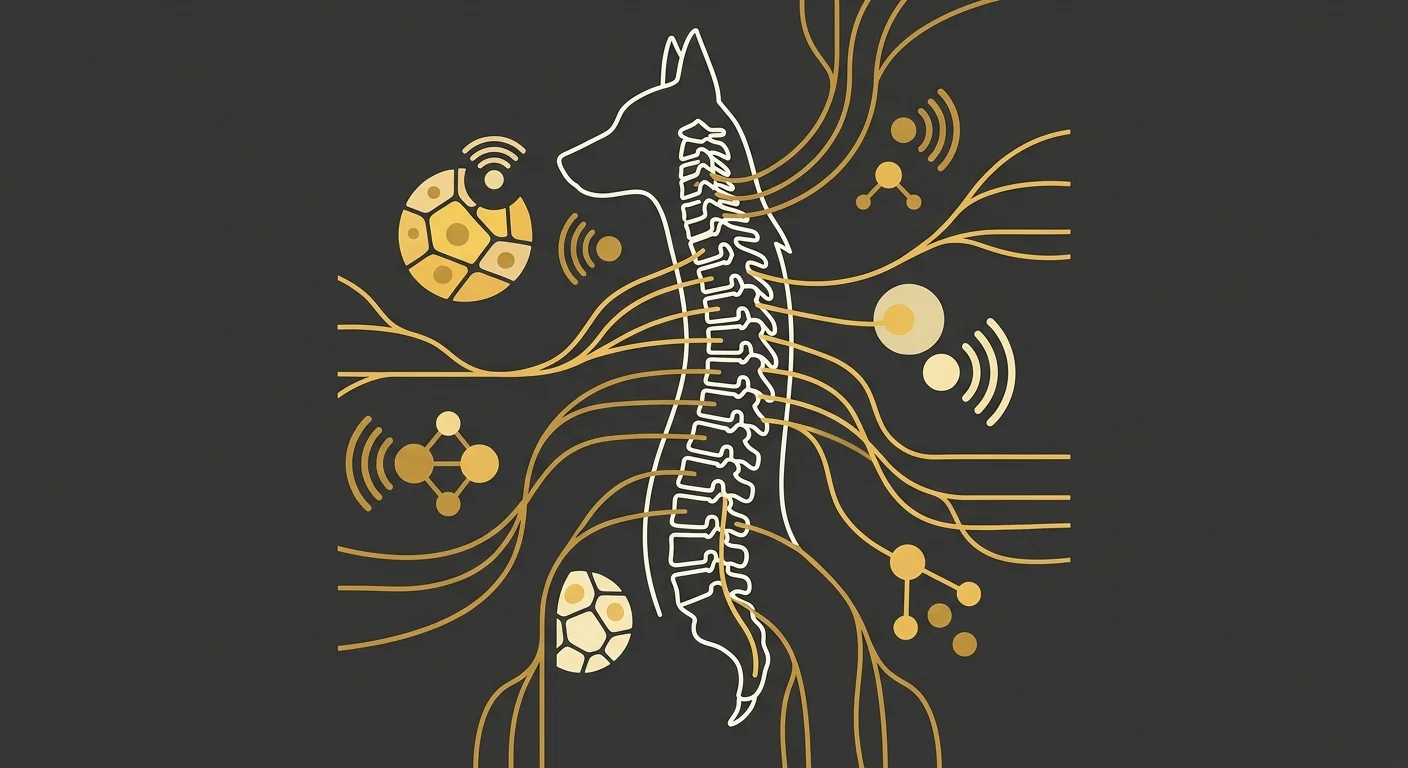
The adjustment doesn't finish the job. It starts it.
A chiropractic adjustment restores proper segmental mobility to the spine. The nervous system doesn't just switch back on — it recalibrates. And that recalibration moves through a distinct biological sequence over days, not hours.
Biomechanical research confirms spinal adjustments produce verifiable increases in segmental vertebral mobility and reduce localized muscle splinting in canine spinal segments. In plain language: the muscles that had been bracing around a restricted joint stop gripping so hard.
The nervous system's output to those muscles changes. The animal's movement reflects that shift — gradually, as the signal stabilizes.
That's exactly why "they seem better" is such an unreliable read.
The nervous system's recalibration isn't linear. It isn't consistent hour to hour. An animal can move freely in the morning and stiffen slightly by afternoon — not because the adjustment failed, but because the system is still integrating.
Owners who understand that don't spiral when they see variability. They track it. That's the whole reason home movement tracking protocols exist — to give owners a structured framework for interpreting what the nervous system is actually producing, instead of reacting to what it looks like on any given hour.
The Neurological Reset Window
The first 7 to 10 days following a chiropractic adjustment are the primary observation window. NIH force-plate research documents that limb weight-bearing symmetry increases significantly within that window — meaning the nervous system is actively redistributing load across the limbs as muscle inhibition decreases and segmental mobility improves.
That's not a subtle shift. It's a measurable one. And it's only visible if you're watching for the right thing.
What's happening underneath that shift is a neurological reset. The adjustment removes mechanical interference from the spinal segment. The nervous system receives cleaner proprioceptive input. Motor output to the surrounding musculature begins to normalize.
It's not magic. It's signal quality.
And signal quality is exactly what individualized chiropractic care is designed to restore — in each specific animal, based on what that animal's body is actually reporting.
The reset window is also when off-weighting patterns are most likely to visibly reduce. Owners watching closely during these days — tracking consistency in weight distribution across all four limbs, noting how the animal loads each paw during a controlled walk — are gathering neurological data.
Owners who aren't watching closely are collecting feelings.
One tells you something real. The other tells you nothing you can act on. This window doesn't reward passive attention — it rewards a protocol.
| Recovery Day Range | Neurological Activity | Observable Owner Signal | Action |
|---|---|---|---|
| Days 1–2 | Nervous system begins receiving cleaner proprioceptive input; restricted spinal segment releases initial muscle bracing | Pet may rest more than usual; mild fatigue or temporary stiffness is normal — not a sign the adjustment failed | Keep activity to short, controlled leashed walks only; no running, jumping, or stairs |
| Days 3–4 | Motor output to surrounding musculature starts normalizing; off-weighting patterns begin to shift as the system integrates new segmental mobility | Watch for subtle changes in how the animal loads each paw; hesitation or uneven stance may visibly reduce during walks | Begin consistent daily observations at the same time and conditions; note any change in weight distribution across all four limbs |
| Days 5–6 | Proprioceptive signal quality continues stabilizing; muscle splinting around the adjusted segment decreases as the nervous system recalibrates | Stride may appear freer or slightly longer; the animal may initiate movement with less hesitation than in the first two days | Track stride reach — does the animal step further forward with each stride compared to day one? Note it. Don't rely on memory. |
| Days 7–10 | Primary recalibration window reaches peak measurable output; weight-bearing symmetry and segmental mobility reflect the adjustment's full neurological effect | The clearest window for observing reduced off-weighting, improved limb loading, and extended joint range during controlled movement | Compare observations from day one to today — this is your baseline versus progress snapshot; flag any persisting asymmetry for the next clinical visit |
| Beyond Day 10 | Nervous system has largely integrated the adjustment; any remaining compensation patterns reflect the animal's structural baseline between sessions | Movement should feel more consistent day to day; variability between morning and afternoon should be reduced compared to the first week | Maintain structured observation notes and report findings at the follow-up visit — this data drives the next care decision |
Home Movement Tests Any Owner Can Run
The window is open. Now run something in it.
Not a feeling. Not a general sense of 'he seems better.' Specific, repeatable tests — same route, same conditions, every single time.
These aren't clinical procedures. They're structured observations — a leash walk, a controlled backyard, eyes that know what to look for.
But they generate real, consistent data. And that's what a recovery story actually needs.
The goal isn't to replace what happens in the adjustment room. It's to make the time between appointments mean something.
What you bring back — real observations, logged consistently — gives the clinician something to work with. Not a shrug and 'he seemed fine all week.'
The Weight-Bearing Symmetry Check
Start here.
Weight-bearing symmetry is the earliest visible sign that a post-adjustment neurological shift is actually happening. And you don't need any equipment to see it.
On a controlled leash walk — flat ground, consistent pace — watch how each paw loads the surface. Full contact on every step? Or is your dog stepping lighter on one limb, hesitating before loading it, swinging that hip outward to compensate?
Those are off-weighting patterns. They're the nervous system's workaround for restricted segmental mobility. NIH kinematic studies confirm that limb weight-bearing symmetry increases significantly within 7 to 10 days following a physical adjustment — so you're watching for those compensations to gradually disappear across that window.
That's not a subjective read. That's a measurable trend.
Log what you see after every walk. Same route, same surface, same pace — every time.
Consistent conditions are what turn observations into data. A dog that off-weights on day two and loads evenly by day eight is showing you something real. A dog that 'seemed fine Tuesday and off Friday' — different walks, different terrain, different energy levels — is showing you nothing you can act on.
The conditions are the protocol. Don't skip them.
Stride and Range-of-Motion Tracking
Next: stride and joint range of motion.
This is where the thermometer-versus-feeling gap gets hardest to ignore.
Watch the trot, not the walk. A purposeful trot — light leash guidance, the animal moving freely — is where stride changes actually show up.
Is the rear leg extending fully at push-off, or stopping short? Is the front leg reaching forward with the same range it had before the restriction? Kinematic gait research confirms that trotting stride length and maximum joint extension angles recover measurable distance following spinal treatment.
On your afternoon walk, that looks like a dog stepping further forward, pushing further back, carrying its back more level than it did the week before. That's not a feeling. That's a direction.
Passive range-of-motion testing closes it out. With your dog standing calmly or lying on its side, gently guide the affected limb through its natural arc — note how far it flexes inward and how far it extends outward before you feel resistance.
You're not forcing anything. You're establishing a baseline. Then you compare that baseline, session by session, against what the limb is willing to do on its own.
Active flexion rounds it out — whether your dog voluntarily bends that joint during normal movement, without prompting. Together, passive extension and active flexion give you a functional neurological read that no single glance at a trotting dog ever could.
Three tests. Two limb directions. One consistent log. That's the home movement tracking protocols framework — and it's how owners stop guessing and start knowing.
| Movement Test | What to Observe | Positive Recovery Signal | Flag for Provider If |
|---|---|---|---|
| Weight-bearing symmetry walk | Whether each paw makes full, even contact with the ground during a controlled leash walk on flat surface | Gradual reduction of off-weighting habits — dog loads each paw more evenly with each passing day | Persistent favoring of one limb after the primary observation window, or sudden increase in off-weighting after initial improvement |
| Trotting stride assessment | Reach and push-off distance of each limb during a purposeful trot — rear leg extension at push-off, front leg reach at landing | Stride length visibly increases; rear legs push further back and front legs reach further forward compared to day one | Stride remains consistently shortened on one or both sides, or animal breaks from trot into a compensating gait pattern |
| Passive range-of-motion test | How far the affected limb flexes inward and extends outward before resistance is felt when the animal is calm and stationary | The limb moves through a wider arc with less resistance session over session — the boundary of comfort extends | Hard stop or flinch response at the same point across multiple sessions with no improvement in range |
| Active flexion tracking | Whether your dog voluntarily bends the joint during normal movement — stepping over obstacles, going up or down a curb, navigating uneven ground | Dog initiates bending of the joint without hesitation or compensation on obstacles it previously avoided or struggled with | Dog consistently avoids or compensates around movements requiring joint flexion, or visibly guards the limb during voluntary activity |
| Stair or incline loading | How the animal distributes weight and sequences its limbs when ascending or descending a consistent staircase or gentle slope | More fluid, even limb sequencing with each session — less pausing, less hip-shifting, less rear-end avoidance on the way up | Refusal to engage stairs at all, bunny-hopping rear limbs together on ascent, or increased hesitation compared to earlier in the tracking window |
| Resting posture check | How your dog positions itself when lying down — whether it sprawls symmetrically or consistently curls away from one side | Animal begins resting in more symmetrical positions and changes sides more freely during naps or downtime | Animal persistently avoids lying on one side, rises stiffly every time from the same position, or shows new guarding behavior at rest |
What to Record and When
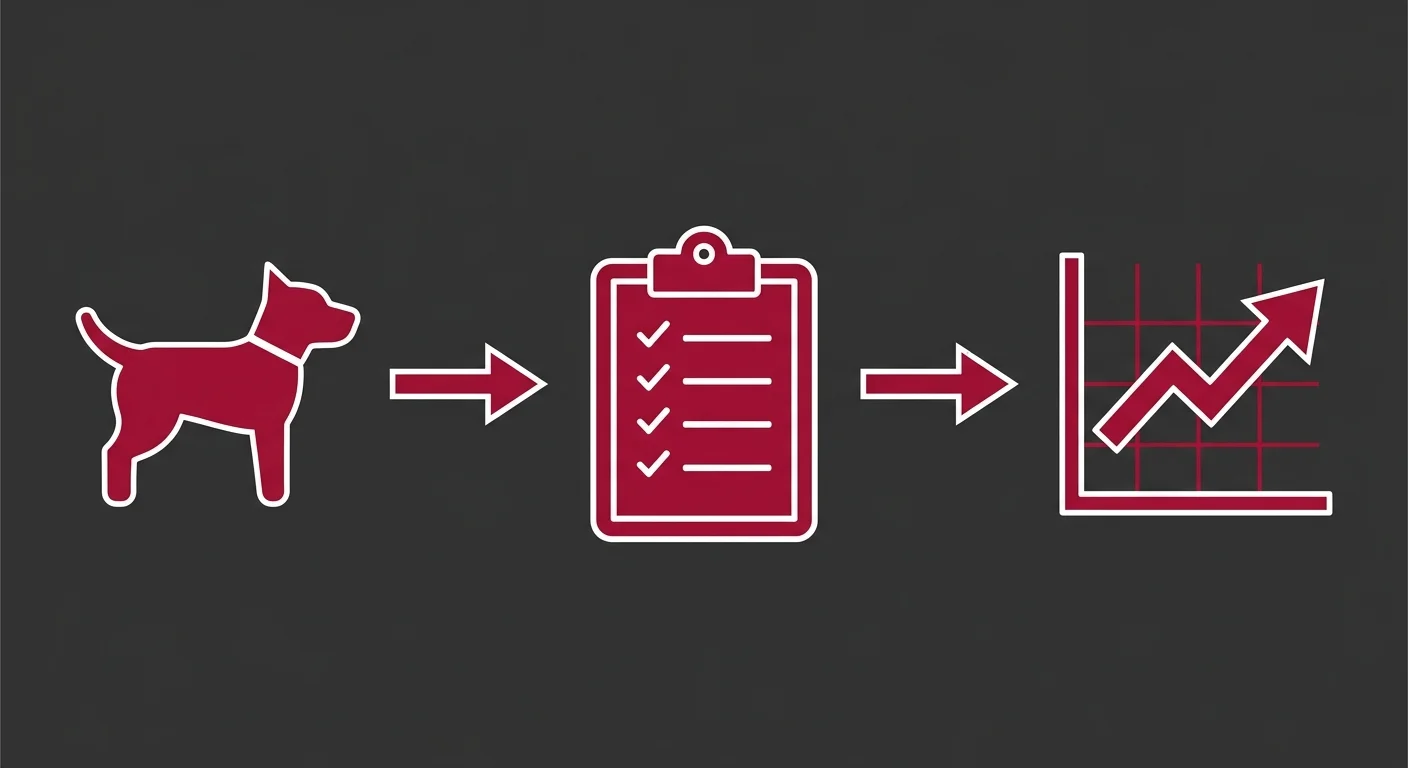
The tests are worth nothing without the record.
Running the same observations every day and trusting your memory to hold the pattern isn't tracking. It's guessing with extra steps.
Format consistency is what turns a daily observation into something a practitioner can use.
Same fields. Same time. Same conditions. That's what gives your provider a real clinical baseline when you come back in — and what lets you spot the difference between a trend and a one-off before you ever walk through the door.
Here's what most owners miss: the parameters flagged during the initial diagnostic exam are the same ones that signal resolution.
Knowing what got restricted at intake tells you exactly what to watch at home. The log isn't a separate document you hand over at the next visit. It's a live extension of the clinical picture — and it only works if you know what you're continuing.
Building a Simple Observation Log
Keep it simple.
A log that takes five minutes to abandon on day three is worse than no log at all. Three to five consistent fields, recorded once daily at the same point in your routine — after the morning walk is the most reliable anchor — is all you need.
Every entry needs five things.
Date and day number post-adjustment. Weight-bearing observations — which limb, what pattern, whether contact was full or subtly off. Stride quality at the trot — full rear extension, shortened reach, or any back-leveling you noticed. Passive range of motion if you tested it that day: which direction felt restricted, how far the limb moved before you hit resistance. And one line flagging anything unusual — a hesitation on stairs, reluctance to turn one direction, a posture shift that wasn't there yesterday.
Force-plate research confirms that weight-bearing symmetry shifts are most pronounced between days 7 and 10 post-adjustment. Your log needs to run continuously across that entire window — not pulled out only when something looks wrong.
Some patterns don't wait for the next scheduled visit.
Any sudden increase in off-weighting after two or more days of consistent improvement. A visible stride shortening that wasn't there the day before. Resistance during passive range-of-motion testing that feels sharper than your established baseline.
Gradual variation is normal — the nervous system's recalibration is not a straight line. Sharp reversals are not normal. Your log is the only thing that tells you which one you're actually looking at.
That distinction is the thermometer. Everything else is just a feeling.
| Observation Category | What to Note | Frequency | When to Escalate |
|---|---|---|---|
| Weight-bearing symmetry | Which limb off-weights, how the foot contacts the surface, visible hip compensation or lateral shift during loading | Once daily — after the morning walk, same route and pace each time | Any sudden increase in off-weighting after two or more consecutive days of improvement |
| Trotting stride length | Whether the rear leg reaches full extension at push-off, whether the front leg reaches forward evenly, whether the back stays level or dips | Once daily during a purposeful trot — not a slow walk | Visible shortening of stride length that was not present the previous day |
| Passive range of motion | How far the limb flexes inward and extends outward before resistance is felt — note the direction and the stopping point | Once daily when the animal is calm; compare directly to your established baseline | Resistance that feels sharper or occurs earlier in the arc than your recorded baseline |
| Active joint flexion | Whether the animal voluntarily bends the joint during normal movement — stepping, turning, rising from rest | Observed continuously during daily activity; log notable changes once per day | Reluctance to bend the joint in situations where the animal previously moved freely |
| Unusual behavioral signals | Hesitation on stairs, reluctance to turn in one direction, posture shifts during standing or resting, changes in willingness to jump or descend | Log any occurrence as it happens — one line per entry, dated and time-stamped | Any new hesitation or posture change that appears after a period of consistent improvement |
The Post-Adjustment Activity Window
Measurement only works when variables stay controlled.
And the biggest variable — the one most owners blow right past — is what their pet does between tracking sessions.
This isn't about being precious with your pet after an appointment.
It's about protecting the neurological recalibration that's already running — so that what you observe at home reflects the adjustment's actual effect, not a setback from too much too soon.
Those are two completely different readings. And without activity control, you can't tell which one you're looking at.
That thermometer framing only holds if the conditions around it stay consistent.
If your pet runs full-speed across the yard at 8 a.m. and you're logging stride length at 2 p.m., you're not measuring recovery. You're measuring inflammation response. Those are not the same data point.
Clean tracking requires clean conditions. That's not a preference — it's the whole premise.
Activity Restrictions That Protect the Adjustment
Post-treatment protocols are direct on this: short, controlled leashed walks are the right baseline during the initial adjustment window.
Not off-leash. Not fetch. Not couch-jumping or roughhousing with the other dog.
Controlled. Leashed. Consistent.
High-impact movement — running, jumping, hard directional cuts — puts exactly the mechanical load on spinal segments that the adjustment just addressed.
Allowing it too early doesn't just risk re-restriction. It poisons every data point you've collected.
Off-weighting on day four after an off-leash sprint tells you nothing about the adjustment. It tells you about the sprint. Those aren't interchangeable readings.
Keep the monitoring environment consistent: same route, same pace, same leash length, same surface.
Active flexion and passive extension observations are only comparable session to session when the conditions producing them don't change. Switch the route, change the terrain, add a distraction — and you've broken the comparison.
That consistency is what turns your home log from a journal into evidence. The kind the clinicians at Touch of Wellness Chiropractic can actually use to make the next clinical call.
| Activity Type | Initial 48–72 Hours | Days 4–7 | Day 8 Onward |
|---|---|---|---|
| Short controlled leashed walks | Primary and only permitted outdoor activity — flat surface, consistent pace, same route each session | Continue as baseline; begin observing stride quality improvements emerging during trot phase | Gradually reintroduce normal walk duration if weight-bearing symmetry and stride length are trending consistently |
| Off-leash running or fetch | Completely restricted — places immediate mechanical load on spinal segments the adjustment just addressed | Still restricted — neurological recalibration is active and data must remain clean | Reintroduce only after practitioner confirms resolution of off-weighting and stride deficits |
| Jumping onto furniture or into vehicles | Prohibited — sudden impact forces disrupt the recalibration window and compromise tracking data | Prohibited — no change; assist the animal onto and off of all elevated surfaces manually | Resume with practitioner guidance once passive range-of-motion baselines normalize |
| Rough play with other animals | Not permitted — unpredictable directional changes and sudden physical contact introduce variables that corrupt mobility observations | Not permitted — same rationale; controlled conditions must be maintained across the full tracking window | Reintroduce cautiously once stride and weight-bearing metrics have stabilized across multiple consecutive sessions |
| Passive range-of-motion testing at home | Begin establishing baseline — gentle guided flexion and extension, noting resistance point and available arc | Compare daily against day-one baseline; flag any sharp increase in resistance as a priority observation | Continue as a maintenance check; bring session notes to the next clinical appointment |
| Stairs and uneven terrain | Avoid where possible — inclines and unpredictable surfaces introduce compensatory loading patterns that obscure limb symmetry data | Reintroduce only on flat, predictable surfaces under controlled leash guidance; monitor for hesitation or avoidance | Resume normal terrain access gradually, using any returning hesitation as a data point rather than a dismissible behavior |
Who Should Perform Animal Chiropractic — and What to Look For
But here's the thing: none of those numbers matter if the adjustment that started the process was done wrong.
The quality of the adjustment is the first variable. It determines what there is to measure.
That's not a positioning statement. It's what the research says.
Biomechanical evaluations confirm that spinal work increases range of motion and reduces localized muscle splinting in canine spinal segments — but those outcomes depend entirely on the practitioner's training, precision, and integration with the animal's full physiological picture.
The thermometer analogy holds: the tool is only as reliable as the calibration. An uncalibrated instrument doesn't give you bad data. It gives you confident bad data. That's worse.
So the first question isn't how to track your pet's recovery.
It's who performed the adjustment — and whether that person is actually qualified under the standards that govern this field. Start there.
Credentials That Actually Matter
The guidelines aren't ambiguous: clinical Animal Chiropractic must be performed exclusively by practitioners holding AVCA or IVCA certification.
That requirement exists because Animal Chiropractic isn't an add-on skill. It's a credentialed specialty — one that demands advanced anatomical training and mandatory integration with conventional veterinary diagnostics.
There's no workaround for that standard. And there shouldn't be.
AVCA certification isn't a weekend course you take between other credentials.
It requires completing a rigorous post-graduate program in animal spinal mechanics, neurological assessment, and hands-on technique under supervised clinical hours. That's not a formality — it's the floor.
And here's what most pet owners don't realize: an uncertified adjustment doesn't just fail to help. It can produce the kind of mechanical disruption that makes your home tracking data look like recovery when it isn't. You'd be logging a trend in the wrong direction and reading it as progress. That's the reason the credential exists.
Dr. Karen Hannah holds AVCA certification — which means the adjustments performed at Touch of Wellness Chiropractic aren't isolated treatments.
They're integrated into a whole-body biological systems read, informed by a zoology-based clinical lens that makes the neurological feedback you're collecting at home actually interpretable.
What you log between appointments lands in clinical hands that know how to use it. That's the difference between tracking progress and generating data nobody acts on.
| Credential or Standard | What It Means Clinically | Why It Affects Your Pet's Outcomes |
|---|---|---|
| AVCA or IVCA Certification | Confirms the practitioner completed a rigorous post-graduate program in animal spinal mechanics, neurological assessment, and supervised clinical technique — not a weekend seminar | Certified adjustments are executed with anatomical precision specific to each species; uncertified work risks mechanical disruption that no home tracking protocol can detect or correct |
| Mandatory Integration with Veterinary Diagnostics | Certified practitioners are required to coordinate with conventional veterinary findings — the adjustment doesn't happen in isolation from the animal's broader health picture | Integration means the practitioner is working from a complete physiological read, not guessing; what you observe at home is measured against a clinical baseline, not a subjective impression |
| Species-Specific Anatomical Training | Animal chiropractic certification covers the structural and neurological differences across species — canine spinal mechanics differ meaningfully from human or equine anatomy | Technique calibrated to the animal's actual anatomy produces measurable changes in mobility and muscle tension; generic or cross-trained approaches produce inconsistent results that undermine your tracking data |
| Whole-Body Biological Systems Read | The most qualified practitioners assess the animal as an integrated biological system — nervous system, musculoskeletal structure, and behavioral signals together — rather than treating an isolated segment | A systems-level assessment identifies compensatory patterns your home log may flag but can't explain; it's the clinical context that makes your tracking data actionable |
| Ongoing Clinical Reassessment | Credentialed practitioners adapt the care plan based on what the animal's response data actually shows — not a fixed protocol applied regardless of outcomes | If your home log shows a plateau or a sharp reversal, a qualified practitioner changes course; one running a preset protocol doesn't — and the distinction shows up in your tracking data within days |
| No Certification — Unlicensed Adjustment | No credentialing body, no required anatomy training, no integration with veterinary diagnostics, no supervised clinical hours — performed outside the standards governing this specialty | Outcomes are unpredictable and unverifiable; home tracking data collected after an uncertified adjustment measures an unknown intervention — making trend interpretation clinically meaningless |
Frequently Asked Questions
The framework gives you the method. These questions give you the reality check.
How fast. What does it actually look like. And how do you tell real progress from a bad day. Those are the questions owners actually ask — so here are the straight answers.
How soon after an animal chiropractic adjustment should I see improvements in my pet's mobility?
Don't watch for a transformation. Watch for a trend. Force-plate research (factClaim_02) confirms weight-bearing symmetry shifts are most measurable between days 7 to 10 post-adjustment. The first signs are subtle — a willingness to load a limb that wasn't loading before. That's the data point. That's what you're tracking.
What are the most common signs of a successful chiropractic adjustment in dogs?
Weight returns to a limb that was being off-loaded. Kinematic research (factClaim_03) documents measurable recovery in trotting stride length and joint extension angles after spinal treatment. The animal stops guarding a direction during passive range-of-motion checks. None of those are impressions — they're observable, repeatable changes you can log session to session. That's the difference between a feeling and a finding.
Is it normal for a pet to be sore or tired after a chiropractic adjustment?
Yes — and it's expected. The nervous system just received a significant input. Mild fatigue or short-term sensitivity is a normal response, not a warning sign. It shouldn't worsen past 48 hours. If it does, call your practitioner — don't wait for the next scheduled visit.
How can I objectively measure my dog's range of motion at home?
Start with passive range-of-motion testing. Gently flex and extend each limb, noting where resistance appears. Veterinary rehabilitation guidelines (factClaim_05) emphasize monitoring both active flexion and passive extension boundaries as the core of home movement tracking. You're not measuring degrees — you're building a consistent reference point. Same limb, same direction, same pace at every session. The comparison across sessions is the data. Consistency is what makes the method work.
What activities should my pet avoid immediately following a chiropractic session?
Short, controlled leashed walks only. Post-treatment protocols (factClaim_06) are explicit: no off-leash running, no jumping, no fetch, no rough play during the initial adjustment window. High-impact activity doesn't just risk re-restriction — it wrecks every data point you've been collecting. Clean recovery requires clean conditions. This isn't overcaution. It's the protocol.
How do I know if my pet needs a follow-up adjustment versus more time to recover?
Recovery isn't a straight line — gradual variation is expected, so don't spiral over a single off day. What isn't normal is a sharp reversal. Kinematic gait research (factClaim_03) identifies stride shortening and loss of joint extension as the measurable markers of setback — sudden off-weighting returning after two or more days of consistent improvement is exactly that signal. That's what your log was built to catch. Bring it in. Don't wait for the next scheduled visit.
Measurement Is the Standard of Care
Here's what separates knowing from hoping: a log.
Feelings tell you your dog seems better. Data tells you it is.
A week of consistent stride observations, weight-bearing notes, and passive range-of-motion readings doesn't lie. That's the thermometer. Everything else is still just a feeling.
That's what this entire process has been pointing toward.
Not one appointment and a vague sense of improvement. Not waiting until something goes wrong again to ask whether the adjustment worked.
Real care is measurable. The owner who tracks is the owner who knows — who walks back into the room with stride data, weight-bearing trends, and range-of-motion baselines instead of a shrug. That owner isn't guessing at their pet's recovery. They're part of it.
Bring that standard into the room.
Animal Chiropractic at Touch of Wellness Chiropractic is where that log becomes a clinical decision.
An AVCA-certified practitioner who can read what you've collected — and turn a week of home observations into the next precise adjustment — is not the same as a provider who just asks how your pet's been doing and takes your word for it.
A thermometer, not a feeling. That's the standard. Now decide if you're tracking to it.
The log means nothing sitting on your counter. Bring it to someone who can read it. An AVCA-certified practitioner doesn't guess at your pet's progress — they confirm it, adjust the care plan around it, and tell you what the numbers actually mean. That's the difference between tracking and doing something with what you tracked.
Copyright Touch of Wellness Chiropractic 2026
1101 W Jackson St, Suite A Morton, IL 61550
Web Design by iTech Valet