
(309) 321-8412 | 1101 W Jackson St, Suite A, Morton, IL 61550
(309) 321-8412 | 1101 W Jackson St, Suite A, Morton, IL 61550
Medical Stress Relief Medications vs. Biological Restoration: What Your Nervous System Actually Needs
Medical stress relief medications and biological restoration are not the same thing. One pulls the battery out of the alarm. The other puts out the fire.
When the body is under chronic stress, the autonomic nervous system locks into a sustained fight-or-flight state. Adrenaline spikes. Cortisol floods the system. Heart rate and blood pressure climb within milliseconds. That is not a chemical imbalance. That is a biological emergency signal the nervous system keeps broadcasting because nothing has physically reset it.
Chemical stress medications interrupt that signal at the neurochemical level. They disrupt the signaling cascades that produce acute feelings of anxiety. The noise stops. But the underlying chronic sympathetic overload in the autonomic pathway stays completely unaddressed. The fire is still burning.
Biological restoration targets the structural source of the dysfunction. Spinal adjustments directly influence autonomic nervous system activity. Measurable shifts in heart rate variability parameters indicate a move toward parasympathetic dominance after intervention. That is the body's rest-and-recovery mode — not chemically induced sedation, but a real, measurable shift in how the nervous system is functioning.
Chronic stress also causes physical damage that no medication addresses. Prolonged sympathetic activation alters cytokine profiles, contributing to systemic inflammation. Physical tension and chronic musculoskeletal pain are globally recognized manifestations of a nervous system that will not stand down. Up to 40% of workers report their job is extremely stressful, with documented physical health consequences. These are not feelings. They are structural and biological events happening inside the body.
The difference between medications and biological restoration is not philosophy. It is mechanism. One manages perception. The other addresses function. For people whose stress symptoms have not resolved — whose sleep is broken, whose pain persists, whose body will not settle — the mechanism is everything.
Last Updated: June 22, 2026
- • What Chronic Stress Is Actually Doing to Your Body
- • Why Medical Stress Medications Work the Way They Do
- • What Biological Restoration of the Nervous System Actually Requires
- • How Spinal Adjustment Interacts with the Autonomic Nervous System
-
• Frequently Asked Questions
- • Can prescription stress medications actually repair a damaged nervous system over time?
- • How long does biological restoration take compared to the instant relief of medical stress drugs?
- • What are the common points of failure when using passive rest to treat autonomic nervous system burnout?
- • Why does my primary care doctor prescribe chemical anxiety blockers instead of recommending structural adjustments?
- • Will chiropractic adjustments for stress recovery require me to commit to a long-term treatment contract?
- • The Fire Is Still Burning
What Chronic Stress Is Actually Doing to Your Body
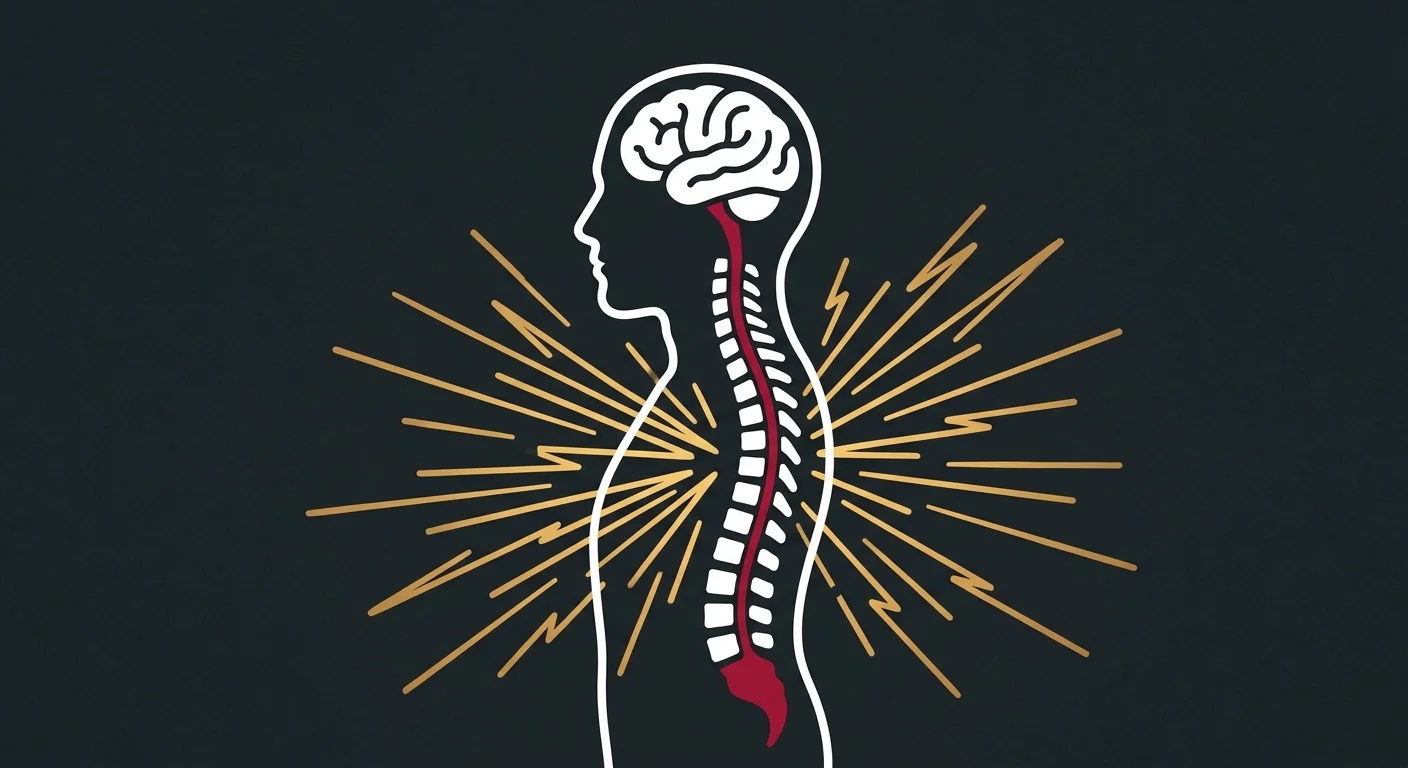
Your body still thinks the threat is here. That's not a feeling. That's a locked biological state.
When stress goes chronic, the autonomic nervous system stops cycling back to rest. It stays in sympathetic dominance — running the alarm without interruption, flooding the body with chemistry built for emergencies. The physical consequences of that locked state aren't abstract. They're measurable, documented, and structural.
That's the fire. And it doesn't go out on its own.
The HPA Axis and the Stress Chemistry Nobody Explains
The HPA axis is the command chain. Hypothalamus detects a threat, pituitary signals the adrenals, cortisol floods the bloodstream. Every system pivots to fight or flight. That's not a flaw in the design — it's the design. It was built to be temporary.
But under chronic stress, it never switches off. According to NIH research, prolonged glucocorticoid elevation leads to hippocampal atrophy — the brain literally losing structure. Sustained sympathetic activation rewrites cytokine profiles, driving up inflammatory markers like IL-6 and TNF-alpha by measurable, documented margins. This isn't stress as a feeling anymore. It's stress as tissue damage.
Here's what nobody says out loud. Most stress conversations stop at symptoms — bad sleep, anxiety, irritability. What's actually happening is a chemistry disruption rewriting biology at the tissue level. Quieting the alarm doesn't reverse that. Not even close.
Why Chronic Stress Becomes a Physical Problem, Not Just a Mental One
Stress doesn't stay in your head. It shows up in tissue, in nerve pathways, in the muscles that won't release no matter how much you stretch them. People working through nervous system stress recovery in Morton hit this early — the physical symptoms they've been treating one by one aren't separate problems. They're the same problem, expressed structurally.
Physical tension and chronic musculoskeletal pain aren't soft complaints. They're a nervous system that won't stand down, showing up in the body as structural events. NIH-documented findings put the number at up to 40% of workers reporting their job as extremely stressful — with physical health consequences that go well beyond mood. Job stress has a direct, documented association with musculoskeletal disorders. That's not anecdote. That's occupational health research.
That distinction changes everything about recovery. If the damage is structural and biological, the solution can't be purely chemical. The fire doesn't care that you've pulled the battery out of the alarm. It's still burning.
| Stress Response Phase | Primary System Activated | Physical Symptom Produced | Duration Before Damage Risk |
|---|---|---|---|
| Acute threat detected | Sympathetic nervous system (SNS) | Heart rate spike, muscle tension, rapid breathing | Resolves within minutes to hours if threat passes |
| Threat signal persists (no reset) | HPA axis — cortisol and glucocorticoid release | Sustained elevated blood pressure, sleep disruption, metabolic dysregulation | Tissue and function changes begin with prolonged activation |
| Chronic sympathetic lock-in | Autonomic nervous system — parasympathetic suppressed | Chronic neck and back pain, headaches, jaw tension, nerve sensitivity | Structural damage risk rises the longer the system stays activated |
| Inflammatory cascade triggered | Immune system — cytokine profile altered | Joint inflammation, widespread musculoskeletal pain, fatigue | Accelerates with each unresolved stress cycle |
| Recovery attempted through chemical intervention only | Neurochemical signaling pathways — acute symptoms masked | Temporary reduction in perceived anxiety, no change in physical state | Underlying autonomic dysfunction remains active and unaddressed |
Why Medical Stress Medications Work the Way They Do
So does standard medicine actually target any of that — the tissue, the cytokine profiles, the nervous system's structural architecture?
It doesn't. It targets the alarm.
Medical stress medications are built around one goal: interrupt the chemistry that produces the feeling of acute anxiety. That's a real intervention. But the mechanism is everything — because interrupting a feeling and correcting the underlying structural dysfunction aren't the same operation. They're not even close.
What These Drugs Are Actually Targeting
Here's what's actually happening in the body. Adrenaline surges drive heart rate and blood pressure up within milliseconds. Cortisol spikes to mobilize glucose and prime every system for a threat. Medications step into that cascade and cut the signaling pathways that make those surges feel unbearable.
The acute experience softens. For a lot of people, that's the only relief they've found — and it's real. But how structural approaches compare to standard stress management makes the gap impossible to ignore: the chronic sympathetic overload in the autonomic pathway stays completely unaddressed. The alarm is quieter. The fire isn't out.
These medications don't restore autonomic balance. They don't reset the nervous system's structural state. NIH clinical documentation confirms that the cardiovascular and autonomic changes chronic stress triggers are physiological events — not just perceptions. Targeting the perception while the physiology runs untouched is the core limitation. You've silenced the readout. You haven't changed what the readout was measuring.
Why Silencing the Alarm Isn't the Same as Putting Out the Fire
This is the fire alarm problem at its clearest. Pull the battery out and the noise stops. The alarm goes silent. But the sustained sympathetic overload, the altered autonomic state, the body that still believes the threat is here — that's still running. Pulling the battery didn't change any of it.
Silencing the alarm feels like relief because the noise was unbearable. But relief and recovery aren't the same word. Recovery means the nervous system has actually shifted state — measurably, structurally, back toward the parasympathetic mode it's built to return to once the threat passes. That shift doesn't happen because the chemical signal got interrupted.
The medications can't do that. They aren't designed to. They're designed to quiet what you feel. What you actually need is for the system running underneath those feelings to change — and that requires a different mechanism entirely.
| Medication Category | Mechanism of Action | What It Does Not Address | Typical Use Case |
|---|---|---|---|
| SSRIs / SNRIs | Disrupt serotonin and norepinephrine reuptake to reduce the felt intensity of anxiety and mood dysregulation | Does not address chronic sympathetic overload, autonomic imbalance, or structural contributors to nervous system dysfunction | Generalized anxiety disorder, depression with anxiety component, long-term daily management of mood symptoms |
| Benzodiazepines | Enhance GABA receptor activity to produce rapid sedation and suppress acute anxiety signals in the central nervous system | Does not reset autonomic state, restore parasympathetic tone, or address the physical tension and musculoskeletal consequences of sustained stress | Short-term acute anxiety relief, panic episodes, situational high-stress events |
| Beta-Blockers | Block adrenaline receptors to prevent the cardiovascular surges — elevated heart rate and blood pressure — that accompany the acute stress response | Does not correct the underlying HPA axis dysregulation or the structural nervous system state driving the cardiovascular response | Performance anxiety, situational stress with strong physical symptoms, short-term cardiovascular symptom control |
| Corticosteroids / HPA Modulators | Regulate cortisol activity and dampen the hormonal cascade triggered by the HPA axis during prolonged stress | Does not reverse tissue-level consequences of sustained cortisol elevation or restore the nervous system's structural cycling between sympathetic and parasympathetic states | Inflammatory conditions worsened by chronic stress, short-term HPA disruption management |
| Sedatives / Sleep Aids | Chemically induce sedation by depressing central nervous system activity to override the arousal state that prevents sleep | Does not address why the nervous system remains in an arousal state — the structural and autonomic dysfunction continues during and after chemically induced sleep | Stress-driven insomnia, acute sleep disruption, short-term symptom relief when nervous system activation prevents rest |
What Biological Restoration of the Nervous System Actually Requires
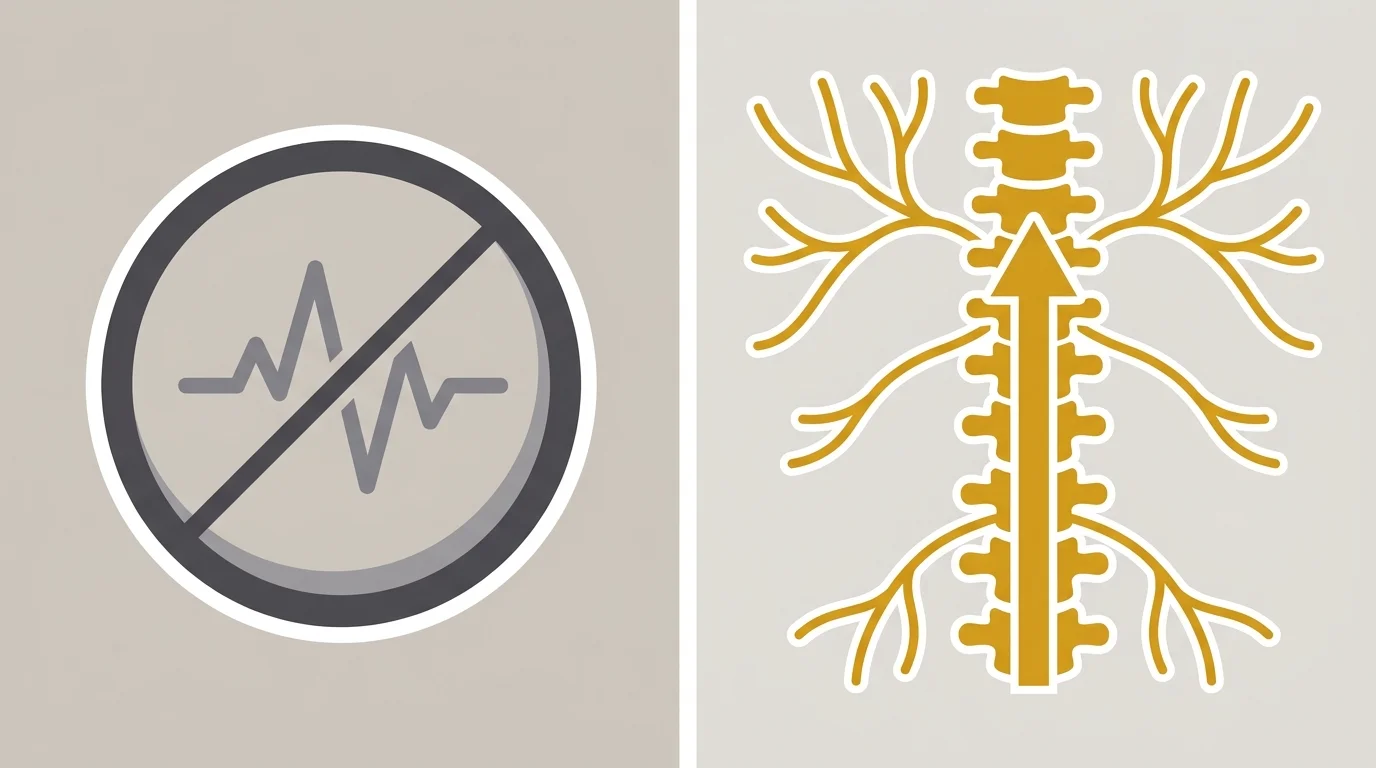
Suppression and restoration aren't two versions of the same treatment. They're opposite mechanisms. Confusing them is exactly why so many people stay stuck.
Biological restoration means the nervous system actually changes state. Not chemically quieted. Not sedated into stillness. The autonomic system physically moves back toward parasympathetic dominance — the mode it's designed to return to once a real threat has passed. That shift requires a structural input. Not a chemical one.
The HPA axis doesn't clock out when the stressor disappears. Glucocorticoids keep driving systemic inflammation long after the original trigger is gone. The body is running a fire that won't go out — because nothing has structurally told the system generating it to stop. You can mask that. You cannot fix it from the outside with a pill.
The Difference Between Suppression and Restoration
Here's the clearest way to say it. Suppression changes what you perceive. Restoration changes what's actually happening in your autonomic system. Those aren't the same operation.
Chemical interventions knock down the signaling cascades that produce acute anxiety. That's real. But the nervous system is still in sympathetic dominance — still flooding tissue with inflammatory chemistry, still running the emergency broadcast. The volume drops. You feel quieter. The fire is still burning. And that's why resting won't resolve what passive rest alone can't fix — if the structural driver of sympathetic overload hasn't been addressed, neither sleep nor stillness can reset it.
Restoration means the autonomic system changes its operating state. Not feels like it did. Actually does. Spinal adjustments that reach the nervous system's structural pathways produce measurable shifts in autonomic balance — moving the system toward parasympathetic dominance, the mode chemical suppression can only imitate. That's the gap that explains why months of managed care haven't moved the needle. The system has to shift. Feeling calmer isn't the same thing.
This Is Not the Right Fit for Everyone
This isn't for everyone. Say that plainly. If you want one adjustment to undo years of chronic stress buildup — that's not what this is. If you're going to decide what your care looks like before the assessment is finished — this isn't the right fit. The assessment drives the plan. Not what your last provider did. Not a timeline someone handed you in the first ten minutes.
Biological restoration is a process — not an event. It takes someone ready to engage it. Someone who understands that chronic tension and musculoskeletal pain aren't random — they're a nervous system that won't stand down, expressed in tissue. Correcting that takes more than pulling the battery out of the alarm. The fire alarm can't tell you the fire is out. Only restoring function can do that.
| Approach | Primary Target | Effect on Autonomic Pathway | Requires Structural Assessment? | Addresses Root Cause? |
|---|---|---|---|---|
| Prescription stress medication | Chemical signaling cascades that produce the feeling of acute anxiety | None — sympathetic dominance remains active; autonomic state is unchanged | No | No — masks symptoms while underlying dysfunction continues |
| Passive rest / sleep | Behavioral downtime | Minimal — cannot reset structural sympathetic overload without an active intervention | No | No — rest cannot address the biological architecture driving the stress response |
| Generic chiropractic protocol (cookie-cutter) | Spinal segments on a fixed sequence regardless of patient presentation | Inconsistent — no assessment of individual autonomic state means shifts are incidental, not targeted | No — protocol is predetermined | Unlikely — same template applied regardless of what's actually driving the dysfunction |
| Individualized chiropractic assessment and adjustment | The structural pathways driving sympathetic overload, specific to each patient's clinical picture | Direct — spinal adjustments influence autonomic balance and promote a measurable shift toward parasympathetic dominance | Yes — assessment drives every care decision | Yes — targets the biological architecture generating the stress response, not just the perceived symptoms |
| Combined structural care and patient engagement | Both the structural drivers and the patient's active participation between appointments | Cumulative — repeated targeted adjustments compound the shift in autonomic state over the care arc | Yes — reassessed and adjusted as clinical picture evolves | Yes — addresses root cause and adapts when something isn't producing results |
How Spinal Adjustment Interacts with the Autonomic Nervous System
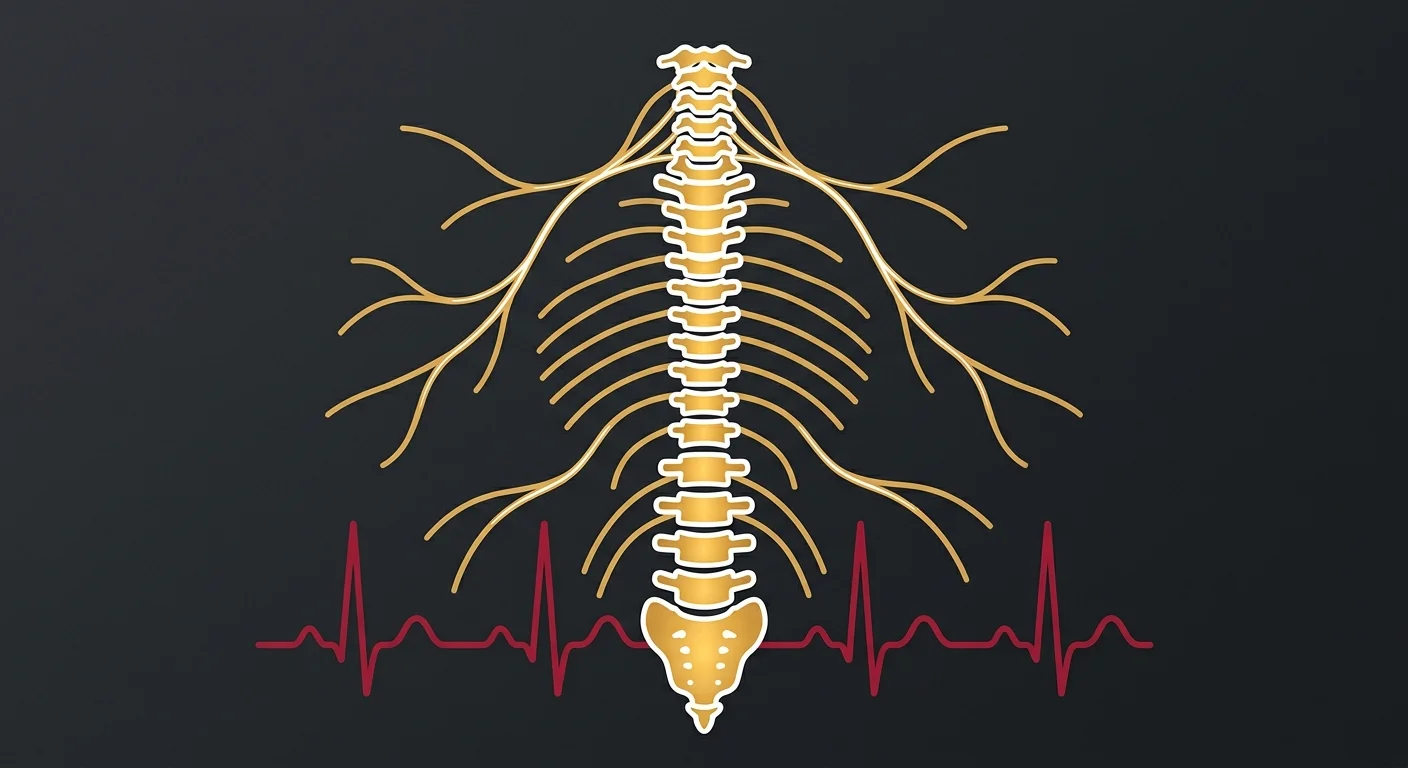
So what does an adjustment actually do? Not philosophically. Mechanically — at the level of an autonomic system that's been locked in overdrive for months.
The spine isn't just holding you upright. It's a direct interface with the autonomic nervous system. When spinal dysfunction develops, it doesn't just produce pain. It actively sustains the sympathetic state that chronic stress locked the body into in the first place. A chiropractic adjustment doesn't chase those symptoms. It introduces a structural input — and the autonomic system responds to that input immediately.
That response is the mechanism. When the adjustment shifts the structural input reaching the nervous system, autonomic balance changes — measurably, in real time. The body isn't being sedated. It's being given a structural reason to shift state. That's not pulling the battery out of the alarm. That's actually addressing what's keeping it triggered.
Heart Rate Variability and the Measurable Shift Adjustments Produce
Heart rate variability — HRV — is the clearest window into autonomic function available. It measures the nervous system's ability to cycle between sympathetic activation and parasympathetic recovery. A chronically stressed nervous system loses that flexibility. HRV drops. The system locks into one gear and stays there. Medications that quiet the feeling of it don't change that. The locked state runs underneath, whether you feel it or not.
NIH peer-reviewed findings show that spinal adjustment alters HRV parameters in ways that indicate a measurable shift toward parasympathetic dominance. The high-frequency and low-frequency spectral components — the actual clinical markers of sympathetic-parasympathetic balance — change immediately following an adjustment. That's not a patient reporting they feel calmer. That's a physiological event captured in data.
That's why how chiropractic care affects systemic cortisol matters clinically — cortisol elevation and sympathetic dominance are part of the same cascade. When the autonomic system measurably shifts toward parasympathetic mode following an adjustment, the broader stress chemistry shifts with it. The HRV data makes that chain of events trackable. Not theoretical.
Why Individualized Assessment Drives This Outcome — and Cookie-Cutter Protocols Don't
But the HRV data tells us something else too. Not every adjustment produces the same shift. The autonomic response isn't uniform — it depends on what's actually driving the dysfunction. The clinical picture has to come first. Always.
The cookie-cutter protocol fails here for a specific reason. Running the same adjustment sequence on every patient — regardless of their history, their presentation, their autonomic state — isn't individualized chiropractic care. It's guesswork applied systematically. And when you're working with a nervous system that's been in chronic sympathetic overload, guesswork doesn't produce the measurable shift the data shows is possible.
Assessment drives the outcome. What's locked, what's compensating, what's sustaining the sympathetic dominance — that picture is different in every patient who walks in. If the adjustment isn't calibrated to that specific picture, you're not addressing the structural pathways driving the dysfunction. You're running a template. And a template can't put out a fire it hasn't looked at.
| Autonomic Marker | Chronic Stress State | Post-Adjustment Response | Clinical Significance |
|---|---|---|---|
| Heart Rate Variability (HRV) | Reduced flexibility — nervous system locked in sympathetic dominance, unable to shift into parasympathetic recovery | HRV parameters alter toward parasympathetic dominance following spinal adjustment | Measurable autonomic shift — not a subjective report but a physiological event captured in clinical data |
| Sympathetic-Parasympathetic Balance | Chronic sympathetic overload — high-frequency and low-frequency spectral components skewed toward sustained activation | Immediate shift in high-frequency and low-frequency spectral components following adjustment | Real-time autonomic rebalancing — the structural input produces a measurable state change, not suppression |
| Cortisol Output | Sustained elevation — cortisol levels spike to mobilize glucose, impairing metabolic and autonomic function when prolonged | Autonomic shift toward parasympathetic mode reduces the stress cascade driving cortisol elevation | Cortisol elevation and sympathetic dominance are part of the same cascade — addressing the structural driver affects the chemistry |
| Cardiovascular Response | Adrenaline surges increase heart rate and blood pressure — system primed for threat response regardless of actual danger | Parasympathetic shift following adjustment begins to counteract the sustained cardiovascular activation state | Chronic stress locks cardiovascular markers into an emergency state; structural intervention addresses the autonomic driver |
| Systemic Inflammatory Chemistry | Prolonged sympathetic activation alters cytokine profiles — IL-6 and TNF-alpha elevated by statistically significant margins | Autonomic rebalancing via structural adjustment reduces the sustained sympathetic state driving inflammatory cytokine output | HPA axis dysregulation is the upstream driver of systemic inflammation — restoration targets the source, not the symptom |
Frequently Asked Questions
Here's where the real questions show up. Not the polished ones. The ones people ask when they've already tried the easy answers and they didn't stick.
They deserve straight answers.
Can prescription stress medications actually repair a damaged nervous system over time?
No. That's not what they're built to do.
Medications disrupt the signaling cascades that produce acute feelings of anxiety. The feeling softens. The architecture generating it doesn't move. The chronic sympathetic overload in the autonomic pathway stays exactly where it is — unaddressed, still running, still driving the dysfunction underneath the quieted surface.
That's managed suppression. It isn't repair.
A nervous system locked in sympathetic dominance for months or years doesn't return to parasympathetic balance because the alarm got quieter. It returns when the structural input driving the overload gets directly addressed. Those are two different operations.
How long does biological restoration take compared to the instant relief of medical stress drugs?
Medications are faster. That's real, and it's worth saying plainly.
Cortisol spikes within milliseconds of a stress trigger. Chemical interventions work at that speed. Biological restoration doesn't — because it's doing something structurally different. It's shifting the autonomic system's actual operating state, not lowering the volume on the distress signal.
How long that takes depends on how long the nervous system has been stuck, what's driving the dysfunction, and how consistently the structural input is applied. There's no honest universal timeline.
But here's what's also honest: if medications have been managing your symptoms for months without resolving them, the timeline for suppression is already longer than you wanted. Speed and resolution aren't the same thing.
What are the common points of failure when using passive rest to treat autonomic nervous system burnout?
The most common failure is treating rest as a structural reset. It isn't.
Passive rest changes the intensity of the demand on the nervous system. It doesn't change the system's operating state. If the autonomic pathway is locked in sympathetic dominance, lying still doesn't shift it. The fire doesn't care that you're horizontal.
The second failure is reading reduced symptoms as resolution. Up to 40% of workers report their job as extremely stressful, with direct physical health consequences — and for most of them, weekends and vacations temporarily reduce the input without touching the structural state chronic stress locked in place. You feel better for a few days. Monday arrives. The system snaps right back.
That's not recovery. That's a pause.
Why does my primary care doctor prescribe chemical anxiety blockers instead of recommending structural adjustments?
Because that's what the training covers. Stress maps to chemistry, and chemical tools are what primary care has. That's not a knock — it's a scope boundary.
The CDC links job stress directly to musculoskeletal disorders. The physical symptoms a chronically stressed nervous system produces — tension, pain, disrupted sleep — aren't a chemistry problem. They're a structural function problem. Most primary care physicians don't have a clinical framework for the relationship between spinal mechanics and autonomic function. They're not ignoring it. They were never trained in it.
That's the gap. And it's exactly what an individually assessed, structurally calibrated chiropractic approach is built to address.
Will chiropractic adjustments for stress recovery require me to commit to a long-term treatment contract?
No. And that answer doesn't come with conditions.
The care plan is built from what the assessment actually shows. Not a billing calendar. Not a scripted retention model. No 18-month plan handed over before anyone's finished evaluating you. No scare tactics about what happens if you stop.
The fear-based sales model — telling patients on visit one they need years of treatment before the assessment is even complete — is the exact approach this practice rejects. It's indefensible. And it's common.
Spinal adjustment measurably shifts HRV parameters toward parasympathetic dominance. That's a physiological outcome, not a retention strategy. The goal is to get your nervous system to a place where it doesn't need to keep coming back. Honest, outcome-based recommendations are the standard here — even when that means a shorter plan than a volume-first model would produce.
The Fire Is Still Burning
Here's the part nobody says out loud. Pulling the battery out doesn't just leave the fire burning. It removes the signal telling you the fire exists.
The nervous system is still in sympathetic overdrive. The structural dysfunction is still running. The emergency broadcast is still live.
But now it's quiet. And quiet feels like resolved.
It isn't. The fire burns without the alarm. That's not recovery. That's delay with the warning light off.
Real restoration means the nervous system has actually changed state. Not sedated. Not dialed down to a quieter version of the same distress. The autonomic system has shifted — measurably, structurally — back toward the parasympathetic mode it's supposed to return to when the threat is gone.
That's what individualized chiropractic care at Touch of Wellness Chiropractic is built to do. Not every patient needs the same input. Not every adjustment produces the same response. The clinical picture comes first.
Because the fire doesn't look the same in every building.
If your symptoms have been managed but never resolved — if the medications quieted the feeling while the physical tension, the disrupted sleep, the nervous system that won't stand down stayed exactly where they were — you already know what happened.
Dr. Karen Hannah starts with one question: what is actually driving the dysfunction in your autonomic system, and what does it take to shift it? Not a template. Not a timeline handed over before the assessment is finished. A real clinical picture — because that's where restoration starts, and that's the only place it can.
Pulling the battery out of the alarm stops the noise. It doesn't put out the fire.
If the tension, the disrupted sleep, and the nervous system that won't stand down are still running the show — that's worth a real conversation. An assessment at Touch of Wellness Chiropractic starts with your actual clinical picture. Not a template. Not a 12-month plan handed over before anyone's looked at anything. Find out what's actually driving it.
Copyright Touch of Wellness Chiropractic 2026
1101 W Jackson St, Suite A Morton, IL 61550
Web Design by iTech Valet