
(309) 321-8412 | 1101 W Jackson St, Suite A, Morton, IL 61550
(309) 321-8412 | 1101 W Jackson St, Suite A, Morton, IL 61550
How to Verify AVCA Credentials: Why Certified Animal Chiropractors Matter
Verifying AVCA credentials means confirming that an animal chiropractor holds a valid, active certification from the American Veterinary Chiropractic Association — the nationally recognized credentialing body for this specialty. That verification isn't optional. It's the difference between a qualified practitioner and someone performing unsanctioned procedures on your animal's spine.
AVCA certification requires a minimum of 210 hours of postgraduate education in animal chiropractic from an approved institution. That coursework covers advanced canine and equine anatomy, neurology, and biomechanics — not general wellness training. After completing that coursework, the practitioner must pass a national certification examination before treating any animal.
In Illinois, the legal standard goes further. The Illinois Veterinary Medicine and Surgery Practice Act mandates that manual therapies on animals can only be legally performed under veterinary referral or direct supervision. An AVCA-certified chiropractor working without that referral isn't just outside best practices — they're outside the law.
The credential is the referral chain made visible. It's verifiable proof of qualification that connects the animal owner, the veterinarian, and the chiropractor into one accountable clinical loop. One link doesn't replace another. All three have to hold.
For animal owners, verification starts with the AVCA's public directory. A certified practitioner's listing confirms active status and the institution where they completed postgraduate training. If a practitioner isn't in that directory — or can't produce certification documentation — that's information worth having before any adjustment happens.
Chiropractic adjustments on an animal's spine affect neurological pathways, spinal mobility, and musculoskeletal compensation patterns throughout the whole structure. Peer-reviewed assessments have documented measurable improvements in gait and restoration of symmetric range of motion following precise adjustments. That precision isn't achievable without the training certification requires. An AVCA credential is the only defensible standard for spinal care in animals.
Last Updated: August 18, 2026
- • What AVCA Certification Actually Means
- • Why Most Owners Skip This Step — and What It Costs
- • How to Verify AVCA Credentials Step by Step
- • Illinois Law, Veterinary Referral, and Why the Legal Layer Exists
-
• Frequently Asked Questions
- • How do I verify if an animal chiropractor is AVCA certified?
- • Why does Illinois law require a veterinary referral for animal chiropractic?
- • What is the difference between an AVCA-certified practitioner and a lay practitioner?
- • How many hours of training does AVCA certification require?
- • Can a human chiropractor adjust my pet without a separate animal chiropractic credential?
- • The Credential Is the Care
What AVCA Certification Actually Means
The AVCA designation isn't something you earn at a weekend seminar. It's proof of demonstrated competency across advanced anatomy, neurology, and biomechanics — specific to the animals being treated — before a single adjustment ever happens.
That distinction matters because a dog's spine isn't a smaller human spine. The neurological architecture is different. The biomechanical load distribution is different. And the consequences of an imprecise adjustment — applied without that specialized understanding — aren't theoretical. They show up in the animal's movement, its pain response, and its neurological function.
So when you're evaluating animal chiropractic for your pet or working animal, the AVCA credential is the clearest signal that the practitioner completed the right preparation. Not general chiropractic training. Postgraduate education designed specifically for this specialty. That's what you're verifying — and that's why it's the right place to start.
The Training Standard Behind the Credential
To sit for the national certification exam, a practitioner must complete a minimum of 210 hours of postgraduate education in Animal Chiropractic from an approved institution. That coursework isn't supplemental. It's the clinical foundation — covering advanced canine and equine anatomy, neurology, and biomechanics at a level that general chiropractic school never reaches.
That number exists because animal spinal care isn't a translation problem. You can't take a human protocol and scale it down. Compensatory patterns work differently across four limbs. Neurological referral pathways are mapped differently. The coursework trains practitioners to see those differences — and to adjust for them precisely, not to approximate from a human model and hope the biology cooperates.
That threshold isn't a bureaucratic floor. It's the minimum competency required to work safely inside the neurological and biomechanical complexity of an animal spine. If you're asking whether any of this is safe to begin with, that question deserves a real answer — and understanding what AVCA certification means for safety is the right next layer of due diligence.
Why the Cookie-Cutter Protocol Fails Animals Too
Here's the thing: a credential only protects an animal if the practitioner actually uses it. That means applying it to the specific animal in front of them — not running a standardized sequence they've used on every case before.
The same adjustment sequence applied regardless of species, breed, age, or injury pattern is the same failure mode that shows up in human chiropractic care. And it's just as damaging here. An animal can't tell you when something doesn't feel right. It can't describe what changed. That asymmetry puts all the diagnostic weight on the practitioner's assessment — which is exactly why assessment has to drive the care plan, not a template.
Academic veterinary centers know this. The University of Illinois College of Veterinary Medicine integrates Animal Chiropractic alongside acupuncture and physical therapy in clinical rehabilitation programs — not as a wellness add-on, but because musculoskeletal restoration in animals requires individualized sequencing. A fixed template applied uniformly across every patient isn't rehabilitation. It's a liability waiting to surface.
That's what an AVCA credential is supposed to guarantee. Not just that the practitioner completed a course — that they assessed this animal, built a care approach from that assessment, and will change course when the response warrants it. The credential makes the referral chain visible: owner, veterinarian, certified chiropractor, all connected. When that chain holds, the animal is protected. When it breaks, the biology absorbs the cost.
| Credential Type | Training Requirement | Exam Required | Veterinary Referral Required | Legal to Practice in Illinois |
|---|---|---|---|---|
| AVCA Certified Chiropractor | Minimum 210-hour postgraduate program in Animal Chiropractic from an approved institution, covering advanced anatomy, neurology, and biomechanics | Yes — national certification exam required before treating any animal | Yes — veterinary referral or direct supervision required under Illinois law | Yes — when operating under proper veterinary referral |
| Licensed Human Chiropractor (No Animal Credential) | Standard chiropractic doctorate — no postgraduate Animal Chiropractic training required | No animal-specific exam required | Yes — referral still required; credential alone does not authorize animal treatment | No — human chiropractic license does not extend to animal spinal care in Illinois |
| Lay Practitioner / Uncredentialed Provider | No standardized training requirement — coursework and competency vary widely or are entirely absent | No exam required — no credentialing body governs practice | No referral chain in place — operating outside statutory oversight | No — unauthorized practice of veterinary medicine; subject to criminal penalty under Illinois law |
| Veterinarian (No Chiropractic Training) | Veterinary medical degree — comprehensive animal health training, but not spinal adjustment methodology | Veterinary licensing exam required — not an Animal Chiropractic certification | No referral required — veterinarian is the supervising authority | Yes — within veterinary scope of practice, but Animal Chiropractic adjustments require specialist training |
Why Most Owners Skip This Step — and What It Costs
Most owners treat animal chiropractic like a massage appointment. They check availability, scan reviews, and book.
Nobody told them a credential existed. So nobody thinks to verify one. That's not carelessness — that's what happens when an industry never explains what its own legal standards require.
Here's what that assumption costs. The Illinois Veterinary Medicine and Surgery Practice Act mandates that manual therapies on animals can only be legally performed under veterinary referral or direct supervision. No referral, no legal treatment. It doesn't matter what the practitioner calls themselves or how many animals they've worked on.
Skipping verification doesn't just put the animal in undertrained hands. It puts the owner inside a care arrangement that's operating outside the law.
When the referral chain holds — owner, veterinarian, certified chiropractor — the animal is protected. When it breaks, the animal's biology absorbs the cost. So does the owner's legal standing.
The Lay Practitioner Problem
Lay practitioners are exactly what credential verification is built to catch. These are individuals performing spinal adjustments on animals — no AVCA certification, no supervising veterinarian, no legal authority to treat in states like Illinois.
And they're not operating in a gray zone. The U.S. Code regulations are direct: unauthorized practice is prosecuted as a Class A misdemeanor for the first offense. Not a fine. Not a warning. A criminal charge.
The harder problem is that lay practitioners often look credible. They use the right language. They post before-and-after videos. Some finished a weekend seminar in animal bodywork.
None of that is AVCA certification. None of it meets the statutory threshold that makes treatment legal in Illinois.
The safety and legal differences explained between certified and uncertified practitioners aren't subtle. One operates inside a legally accountable referral chain. The other operates entirely outside it.
An AVCA credential is the only verifiable signal that the statutory requirements have been met.
This Isn't the Right Fit for Every Owner
This standard isn't for every owner. Worth saying directly.
If you want a quick fix, a low-commitment wellness option, or a practitioner willing to skip the veterinary referral to save time — this isn't that. A practitioner who works around the referral requirement is telling you the AVCA safeguard doesn't apply to them. That's not a workaround. That's a warning.
Owners who get the most out of AVCA-certified Animal Chiropractic are willing to engage the full process — veterinary consultation, documented referral, and care from a practitioner whose credentials show up in a national directory.
That process exists because the animal's spine isn't a casual intervention point. It's a neurological structure. Treating it correctly requires exactly the preparation that certification documents.
If the referral chain feels like too many steps, that reaction tells you something.
The fit probably isn't there. No marketing language from an uncertified practitioner changes what the law requires — or what the animal's biology demands.
| Risk Factor | Uncredentialed Lay Practitioner | AVCA-Certified Practitioner |
|---|---|---|
| Legal authority to treat | None — operates outside state law without veterinary referral or supervision | Legally authorized under veterinary referral or supervision, meeting statutory requirements |
| Credential verifiability | No national directory listing — credentials cannot be independently confirmed | Listed in the AVCA national directory — verifiable by any owner before the first appointment |
| Training foundation | May have completed a weekend seminar or short bodywork course — not postgraduate clinical education | Completed postgraduate coursework in advanced animal anatomy, neurology, and biomechanics specific to the species being treated |
| Veterinary referral chain | No referral required or sought — the accountable clinical loop between owner, vet, and practitioner is broken | Operates within a documented referral chain connecting owner, veterinarian, and chiropractor into a single accountable loop |
| Risk to the animal if something goes wrong | No licensed oversight, no documented care plan, no clinical accountability — the animal absorbs the full consequence | Veterinary oversight and documented referral create a traceable record and a clear accountability structure if the animal's response requires escalation |
| Care approach | Protocol applied uniformly regardless of species, breed, age, or injury pattern | Assessment-driven care built from what that specific animal is presenting — not a fixed template |
How to Verify AVCA Credentials Step by Step
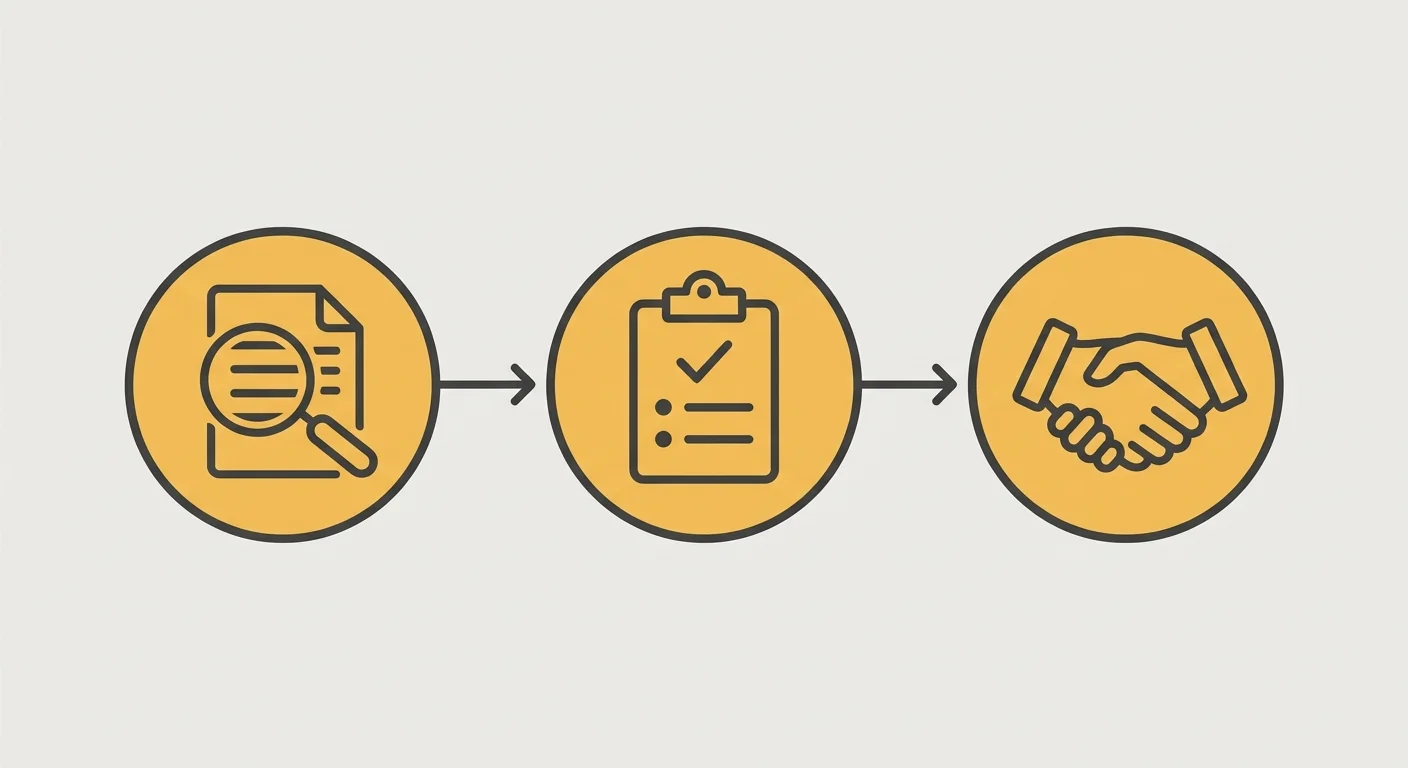
Knowing the standard exists isn't the same as confirming it's been met. That confirmation happens before the first appointment. Not after.
The verification process isn't complicated. But it has to be deliberate. Most owners skip it because they assume a credentialed practitioner would say something if they weren't qualified. That assumption is wrong. And it's exactly the gap uncertified practitioners count on.
- Check the AVCA practitioner directory — this is step one, not the practitioner's own website
- Confirm the veterinary referral is in place before the first appointment is booked
- Ask specific questions about training directly — before you schedule, not after
Using the AVCA Practitioner Directory
The AVCA maintains a publicly searchable directory of certified practitioners. That's the starting point. Not a review site. Not the practitioner's own website. The directory is where verified credentials are actually recorded.
Search by location or by name. Active certification status means this practitioner completed a minimum of 210 hours of postgraduate education in Animal Chiropractic, passed the national certification exam, and is operating under AVCA standards. If they don't appear in the directory — or they show an expired status — that's your answer. Don't book.
But the directory check tells you something beyond a credential. It tells you whether this practitioner is inside the referral chain — or working around it. How chiropractors collaborate on non-surgical care with veterinarians depends entirely on that chain holding. A practitioner who's current in the directory is operating inside that structure. One who isn't — isn't.
Questions to Ask Before the First Appointment
So ask three questions before you book. Is your AVCA certification current? Do you require a veterinary referral before beginning treatment? What does your initial assessment look like for this specific animal? Three questions. The answers land immediately — either you're talking to a certified practitioner operating inside the legal framework, or you're talking to someone filling the role without meeting it.
A practitioner who hesitates on the referral question has already told you something important. The referral isn't a preference. It's a statutory requirement under Illinois law. Certified practitioners treat it that way — because they understand what it protects.
The assessment question is the clinical test. Certified spinal adjustments reduce secondary compensatory muscular strain in animals recovering from orthopaedic injuries — but only when care is built from what that specific animal is actually presenting. A practitioner who can walk you through how their initial assessment drives the care plan is showing you the individualized approach an AVCA credential is supposed to guarantee. One who can't? The template comes first. That's the wrong answer — and it tells you everything.
| Verification Step | What to Check | Red Flag if Missing | Time Required |
|---|---|---|---|
| Search the AVCA Practitioner Directory | Practitioner appears by name with active certification status | Name absent or certification listed as expired or lapsed | Under five minutes |
| Confirm veterinary referral is in place | Documented referral from a licensed veterinarian obtained before the first appointment | Practitioner frames the referral as optional or offers to proceed without one | One to two days depending on your veterinarian's availability |
| Ask about postgraduate training directly | Practitioner can name the approved institution and confirm completion of required coursework covering canine and equine anatomy, neurology, and biomechanics | Practitioner cites a weekend seminar, short course, or general bodywork training as equivalent | A single direct conversation before booking |
| Ask what the initial assessment looks like | Practitioner describes an animal-specific evaluation that drives the care plan — not a fixed protocol applied uniformly | Practitioner cannot describe assessment process or defaults to a standard sequence regardless of presentation | Part of the pre-booking conversation |
| Verify the referral chain is complete | Owner, veterinarian, and AVCA-certified practitioner are all connected — referral is documented, credentials are confirmed, assessment is individualized | Any link in the chain is missing — no referral, unverifiable credentials, or care begun before assessment | Completed before the first treatment session |
Illinois Law, Veterinary Referral, and Why the Legal Layer Exists

These aren't best practices you can opt out of. Illinois law settled that question — and it didn't leave room for interpretation.
The Illinois Veterinary Medicine and Surgery Practice Act is the legal architecture credential verification is built on. Manual therapies on animals without veterinary referral or direct supervision aren't a gray zone. They're outside the law. The credential chain isn't professional etiquette. It's a statutory requirement — and the statute exists because the alternative has a documented cost.
That cost shows up in the animal's body. Imprecise spinal work by an undertrained practitioner doesn't just fail — it creates compensatory strain patterns a certified provider then has to work backward from. The legal layer and the biological layer aren't separate concerns. They're pointing at the same risk.
What the Illinois Statute Actually Requires
The Illinois Veterinary Medicine and Surgery Practice Act is direct: manual therapies on animals can only be legally performed under veterinary referral or direct veterinary supervision. Not "preferably with" a referral. Not "ideally coordinated with" a veterinarian. The statute uses the word "only" — and it means it.
Performing spinal adjustments on animals without meeting that threshold isn't a licensing technicality. It's prosecuted as a Class A misdemeanor for the first offense. That's the legal status of uncertified, unsupervised Animal Chiropractic in Illinois. Practitioners who frame the referral requirement as optional aren't just cutting corners. They're exposing the animal owner to a care arrangement built on illegal footing.
Illinois drew that line for a reason. The spine isn't a casual intervention point — and for horses especially, where owners are often weighing restorative spinal care against symptom-masking options, the legal oversight structure ensures that whoever works on that spine has been credentialed to understand what they're affecting. The referral requirement is the law's way of making sure a veterinarian has eyes on the case before a single vertebra gets adjusted. That's not bureaucratic friction. That's a species-specific safety standard the Illinois legislature decided was non-negotiable.
How Clinical Outcomes Justify the Oversight Structure
The legal requirement didn't get written in a vacuum. Peer-reviewed biomechanical research confirms that precise chiropractic care adjustments significantly improve vertical spinal mobility and restore pelvic symmetry in animals. The word "precise" matters here. Those outcomes depend entirely on assessment quality and adjustment accuracy — which is exactly what the certification process is built to produce. Pull the credential out of that equation and you're not just operating illegally. You're removing the only mechanism that makes the outcome replicable.
And it's not just mobility. Clinical evaluations show that certified spinal work reduces secondary compensatory muscular strain in animals recovering from localized orthopaedic injuries. That reduction happens because the practitioner is working from a complete clinical picture — not running a fixed protocol and waiting to see what breaks. The oversight structure the law requires is what makes that clinical precision possible. Take away the referral chain and you take away the accountability that produces the result.
That's the loop the credential locks in. Owner, veterinarian, certified chiropractor — all connected through a documented referral chain, all accountable to the same standard. When that loop holds, the animal's biology gets the precision the research supports. When it breaks, neither Illinois law nor the animal's nervous system has any protection. The credential is the referral chain made visible. Not the formality. The guarantee that the loop actually closes.
| Legal Requirement | Illinois Statute Basis | Consequence of Non-Compliance | Who Bears the Risk |
|---|---|---|---|
| Veterinary referral or direct supervision required before any manual therapy on animals | Illinois Veterinary Medicine and Surgery Practice Act (Act 1313) | Treatment performed outside this requirement is unlawful regardless of practitioner intent | Animal owner — care arrangement is built on illegal footing without a documented referral |
| Prohibition on unauthorized practice of veterinary medicine by uncertified individuals | Illinois Veterinary Medicine and Surgery Practice Act (Act 1313) | Class A misdemeanor prosecution on first offense | Animal owner — exposed to a care arrangement with active criminal liability attached |
| Precise spinal adjustments must restore symmetric range of motion and measurable gait improvements | Peer-reviewed biomechanical assessments (NIH/PubMed PMC8471131) | Without certified precision, clinical outcomes — including restored pelvic symmetry — are not achievable | Animal — imprecise work by an undertrained practitioner fails to produce the documented biomechanical outcomes |
| Certified spinal work must reduce secondary compensatory muscular strain in orthopaedic recovery cases | Clinical evaluations (NCBI PMC3831613) | Without credential-backed assessment, compensatory strain patterns accumulate rather than resolve | Animal — compensatory muscular strain goes unaddressed and compounds the original orthopaedic injury |
Frequently Asked Questions
The rules aren't complicated. Applying them in the moment — when you're staring at a booking page and trying to figure out if you can trust what it says — that's where owners get stuck.
So here are the questions owners actually ask. About the law, the training gap, and what happens when a practitioner doesn't clear the bar. Straight answers — because the stakes call for it.
How do I verify if an animal chiropractor is AVCA certified?
Start with the AVCA's publicly searchable practitioner directory. That's the authoritative record. Not a review site. Not the practitioner's own website. Search by name or location. If the practitioner appears with an active certification status, the baseline is confirmed. If they don't appear — or show an expired status — that's your answer. Don't book until the directory check is done.
Why does Illinois law require a veterinary referral for animal chiropractic?
Illinois law isn't ambiguous on this. The Illinois Veterinary Medicine and Surgery Practice Act requires veterinary referral or direct supervision before any manual therapy is performed on an animal. It's not a professional preference. It's a statutory requirement. The referral ensures a licensed veterinarian has assessed the animal before anyone adjusts its spine. Without it, the treatment isn't in a gray zone. It's outside the law.
What is the difference between an AVCA-certified practitioner and a lay practitioner?
An AVCA-certified practitioner has completed a minimum of 210 hours of postgraduate education in Animal Chiropractic, passed a national certification exam, and operates inside a documented accountability structure. A lay practitioner has none of that. No credential. No oversight chain. And in Illinois, performing spinal adjustments on animals without meeting that threshold isn't a gray-area licensing issue — it's prosecuted as a Class A misdemeanor on the first offense. That's not philosophical. That's your animal's spine and the law in the same sentence.
How many hours of training does AVCA certification require?
AVCA certification requires a minimum of 210 hours of postgraduate coursework — layered on top of an existing chiropractic or veterinary degree. That's not a weekend seminar. The curriculum covers advanced canine and equine anatomy, neurology, and biomechanics. Then the practitioner sits for the national certification exam. The spine is a neurological structure. Imprecise work on it has real consequences — which is exactly why the training bar is set where it is.
Can a human chiropractor adjust my pet without a separate animal chiropractic credential?
No. A human chiropractic license doesn't authorize spinal work on animals. The credential requirements are separate. Animal Chiropractic requires its own postgraduate certification — through the AVCA or an equivalent credentialing body — regardless of the practitioner's human clinical background. Dr. Karen Hannah holds both: a Doctorate of Chiropractic and a separate AVCA certification in Animal Chiropractic. They aren't interchangeable. One covers the human spine. The other is what makes animal spinal work legal and clinically defensible.
The Credential Is the Care
The credential isn't a formality sitting beside the care. It's what makes the care defensible in the first place.
Every step — the AVCA directory check, the veterinary referral, the assessment questions — traces back to one fact: the animal's spine is a neurological structure.
Not a paperwork problem. A biological one.
Owner, veterinarian, AVCA-certified chiropractor — one referral chain, one shared standard, one point of accountability.
When that chain holds, the animal gets care built from what its body is actually presenting. When it breaks, the law and the nervous system both absorb the damage.
That's not overhead. That's the safety baseline that makes every adjustment defensible.
At Touch of Wellness Chiropractic, Dr. Karen Hannah's Zoology-to-systems clinical lens isn't a background detail. It's the foundation of how Animal Chiropractic gets delivered safely — because whole-body biological systems analysis is what separates a real assessment from a template applied to the wrong patient.
So before the first appointment: verify the AVCA credential. Confirm veterinary oversight is in place. Ask what the initial assessment looks like for this specific animal.
Do all three — and you haven't just followed the law. You've protected your animal's spine from the one thing certification exists to prevent: someone adjusting what they don't fully understand.
Every owner who skips that verification is betting the animal's nervous system that the chain doesn't need to close. It does. And the credential is the referral chain made visible.
You've done the research. You know what the credential means and why the referral chain isn't optional. If you're ready to work with a practitioner who holds an actual AVCA certification, operates inside a veterinary referral structure, and builds every care plan from a real assessment of your animal — not a copied template — book an appointment at Touch of Wellness Chiropractic.
Copyright Touch of Wellness Chiropractic 2026
1101 W Jackson St, Suite A Morton, IL 61550
Web Design by iTech Valet