
(309) 321-8412 | 1101 W Jackson St, Suite A, Morton, IL 61550
(309) 321-8412 | 1101 W Jackson St, Suite A, Morton, IL 61550
How the Trigeminocervical Complex Links Neck Tension to Chronic TMJ Headaches
The trigeminocervical complex is a brainstem junction where the trigeminal nerve — the nerve that serves the jaw, face, and temples — converges directly onto the same neurons as the upper cervical spinal nerves from C1, C2, and C3. That shared wiring is the reason chronic TMJ headaches so often don't respond to dental treatment.
A nightguard addresses the jaw end of the circuit. It doesn't touch the neck. When a restricted upper cervical joint is generating the fault signal, the jaw keeps receiving it — regardless of what's happening at the bite.
The connection runs both directions. Tension in the jaw drives measurable reflex responses in the cervical muscles. Tension in the cervical joints alters jaw muscle tone and bite force through proprioceptive feedback. Neither system operates independently.
The clinical data reflects this. Approximately 70% of patients diagnosed with temporomandibular disorders also present with cervical spine dysfunction. That co-occurrence isn't coincidental — it's anatomical. When the upper cervical spine is addressed directly, documented outcomes include up to a 54% reduction in active TMJ pain index scores.
The jaw is often where the pain is felt. The neck is where it starts.
Last Updated: August 25, 2026
- • What the Trigeminocervical Complex Actually Is
- • Why the Trigeminal Nerve and the Cervical Spine Share the Same Signal Pool
- • The Reflex Loop Most Dentists Never Test
- • What Upper Cervical Dysfunction Looks Like in a TMJ Patient
-
• Frequently Asked Questions
- • What is the trigeminocervical complex, and how does it connect my neck to my jaw?
- • Why doesn't my nightguard stop my chronic TMJ headaches?
- • Can an upper cervical misalignment cause ear pain and jaw clicking?
- • How do chiropractic adjustments in the neck resolve TMJ pain?
- • What are the signs that my TMJ headache is actually coming from my neck?
- • The Breaker That Keeps Tripping
What the Trigeminocervical Complex Actually Is
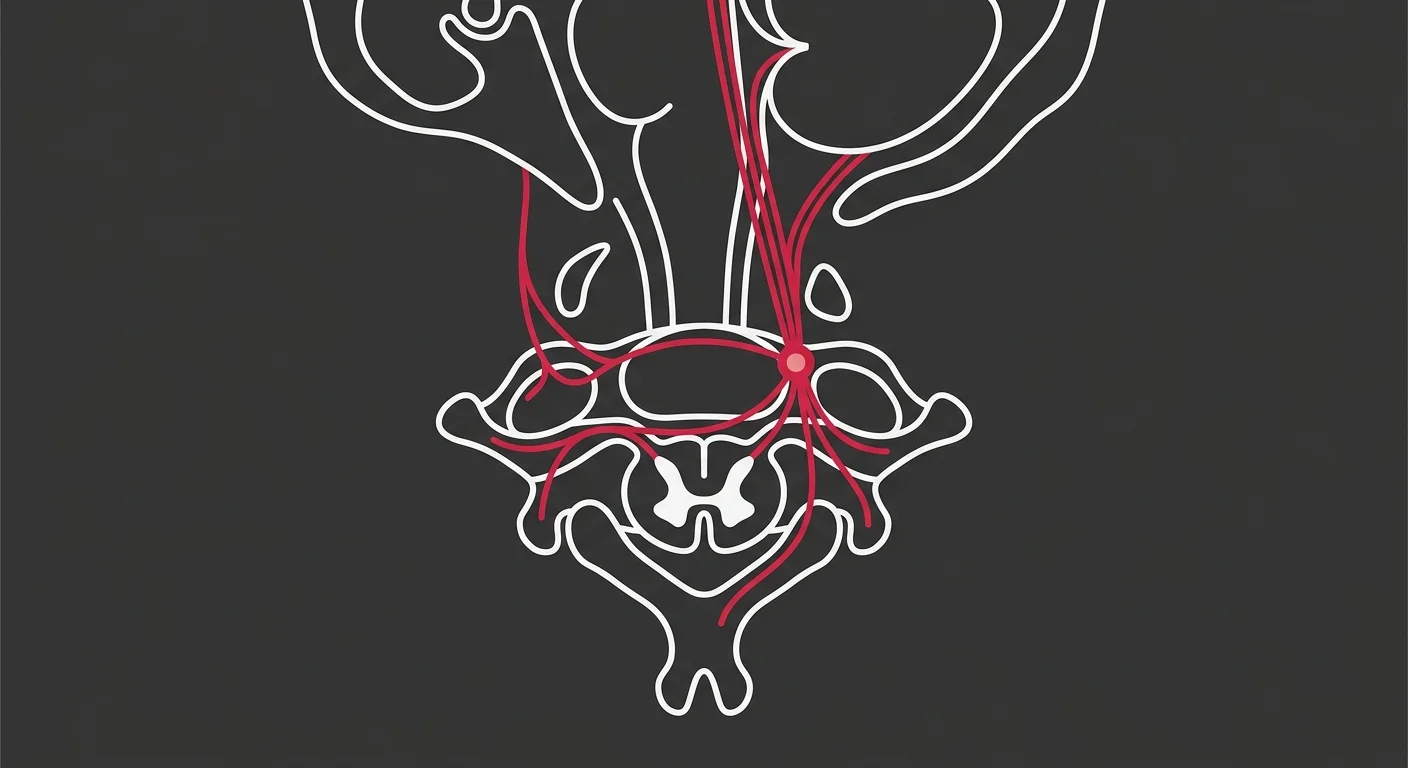
The trigeminocervical complex isn't a theory. It's a specific brainstem junction — the point where the trigeminal nerve's sensory fibers physically share the same second-order neurons as the upper cervical spinal nerves from C1, C2, and C3.
That shared circuitry is why jaw pain and neck pain travel together so often. It's not vague referred pain. It's a structural overlap — the trigeminal fibers covering your jaw, temples, and face converge at the same brainstem neurons as the nerves from C1, C2, and C3. When something goes wrong in the upper neck, that shared switchboard doesn't distinguish where the signal came from.
Most TMJ treatment plans never account for this. They treat the jaw as if it's an isolated system. It isn't.
The Junction Box Between Your Neck and Your Jaw
Think of the trigeminocervical complex as a junction box — the point where the jaw's circuit and the neck's circuit share the same breaker panel. A restricted or misaligned upper cervical joint trips that breaker. And the fault signal doesn't stay in the neck. It travels the shared wire straight to the jaw, the temples, and behind the eyes.
That's not a metaphor — it's what NIH research on trigemino-cervical convergence makes anatomically unavoidable. The upper cervical spine isn't adjacent to the TMJ problem. It's upstream of it. Patients who find that dental splints fail to resolve their headaches are often living with exactly this pattern — a tripped breaker in the neck that no amount of occlusal work can reset.
Fixing the jaw end of the wire — with a nightguard, a bite adjustment, or occlusal splinting — doesn't touch the breaker. The fault signal keeps arriving. The jaw keeps tensing. And the headache keeps coming back.
Why This Anatomy Makes Neck Pain and Jaw Pain the Same Problem
Here's what that anatomy means in a clinical setting. Neck pain and jaw pain aren't two separate problems that happen to coexist. They're one problem with two addresses. NIH-published data shows approximately 70% of patients diagnosed with temporomandibular disorders also present with clinical cervical spine dysfunction. That number isn't a coincidence. It's the trigeminocervical complex doing exactly what its anatomy predicts.
That's why individualized chiropractic care that targets the upper cervical spine produces a different result than dental management alone. When the junction box gets addressed directly, the fault signal stops. The jaw stops receiving a dysfunctional input. And the headache pattern that never responded to nightguard therapy finally has a reason to change.
| Structure | Location | Role in TMJ Pain Pathway | What Gets Disrupted |
|---|---|---|---|
| Trigeminocervical Complex (TCC) | Brainstem junction — where upper cervical spinal nerves meet trigeminal sensory fibers | Central switchboard where neck dysfunction generates jaw, temple, and facial pain signals | Shared second-order neurons misread cervical joint restriction as jaw pain — pain origin becomes anatomically ambiguous |
| Trigeminal Nerve (CN V) | Branches across the jaw, face, temples, and forehead | Carries sensory input from the jaw and face directly into the TCC convergence zone | Receives misdirected fault signals from the upper cervical spine — produces jaw tension and facial pain with no dental cause |
| Upper Cervical Spinal Nerves (C1, C2, C3) | Exiting the spinal cord at the top three cervical vertebrae | Feed proprioceptive and nociceptive signals into the same brainstem neurons as the trigeminal nerve | Restricted or misaligned cervical joints flood the TCC with abnormal input — altering jaw muscle tone and bite force downstream |
| Upper Cervical Facet Joints | C1–C3 vertebral articulations in the upper neck | Mechanoreceptors here continuously report joint position to the trigeminal sensory nucleus | Joint restriction or subluxation sends persistent abnormal proprioceptive signals — driving chronic masticatory muscle spasm without a dental trigger |
| Temporomandibular Joint (TMJ) | Where the mandible articulates with the temporal bone of the skull | Receives efferent motor output shaped by TCC convergence — jaw muscle tone is partly governed by cervical input | Treated in isolation by dental splints and occlusal adjustments — the upstream cervical fault signal goes unaddressed and pain persists |
| Occlusal Splint / Nightguard | Positioned at the bite — between upper and lower teeth | Buffers mechanical wear and reduces direct bite force on the TMJ | Addresses the jaw end of the circuit only — does not reach the TCC, does not reset the cervical fault signal, does not resolve cervicogenic headache patterns |
Why the Trigeminal Nerve and the Cervical Spine Share the Same Signal Pool
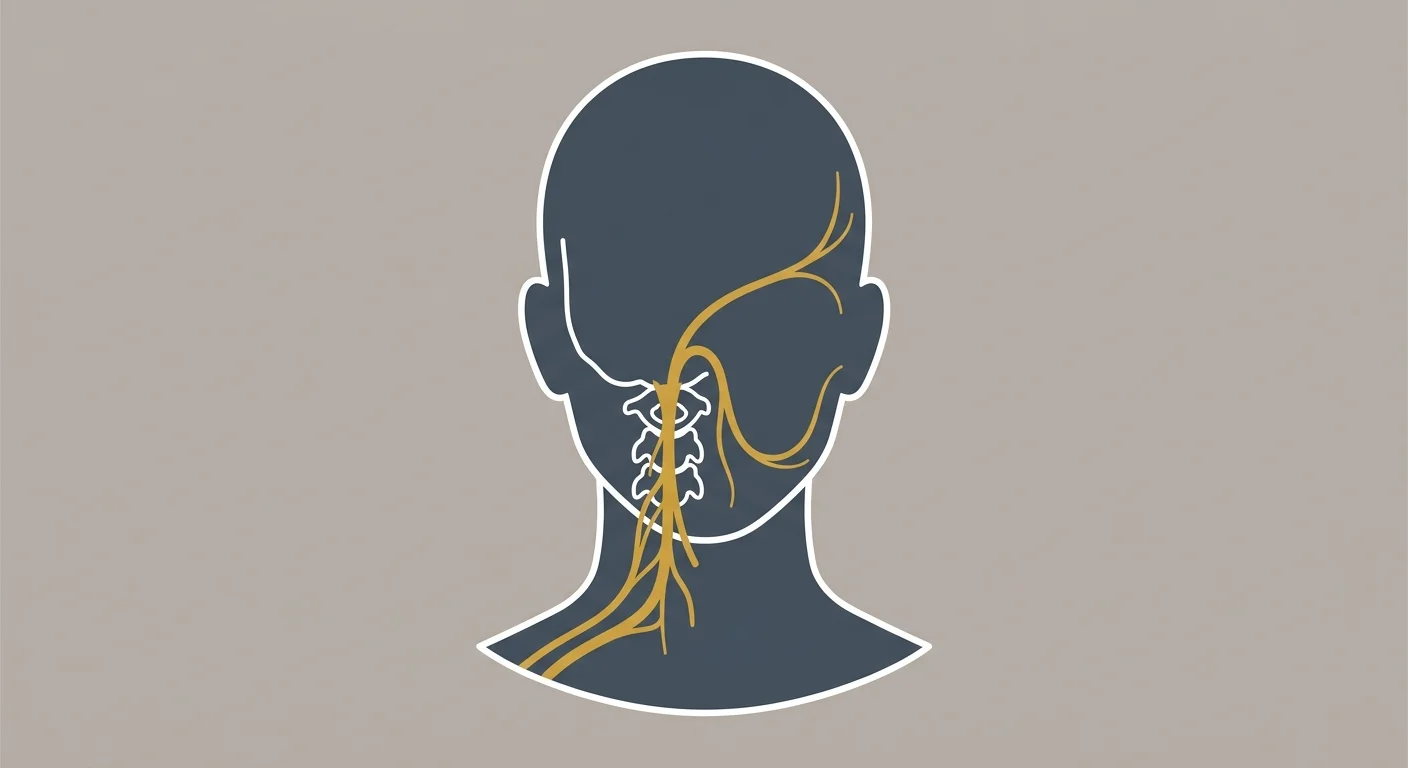
Here's the thing — the trigeminal nerve and the upper cervical spinal nerves don't just run near each other. They share the same second-order neurons inside the brainstem, at C1, C2, and C3. That's not a loose neighbor relationship. That's shared circuitry.
When a restricted upper cervical joint fires pain signals into that shared pool, the brainstem doesn't sort them by where they came from. It routes them the same way it routes jaw input — up into the temples, behind the eyes, across the face. The neck is speaking. The jaw takes the call.
That's the problem with dental-only TMJ management. The jaw is where the signal lands. The neck is where it starts. Treat one without the other and you haven't missed a detail — you've missed the source.
How C1, C2, and C3 Feed Pain Signals Into the Jaw
The C1, C2, and C3 cervical facet joints aren't passive hinges. They're packed with mechanoreceptors — proprioceptive sensors that push constant positional and pressure data directly into the trigeminal sensory nuclei. That feedback loop doesn't just shape how the neck sits. It governs bite force and the resting tone of every jaw muscle.
So when those joints are restricted or misaligned, the data stream gets distorted. The trigeminal nuclei receive a corrupted input. The jaw muscles respond to that corruption — tightening, bracing, pulling the mandible into positions that grind and strain the joint. The jaw isn't overreacting. It's doing exactly what it's being told.
Patients who discover that their jaw pain originates in the upper neck often say the same thing: it wasn't that the previous treatment failed — it was aimed at the wrong address. NIH-documented research confirms this mechanoreceptive feedback pathway, showing that C1-C3 facet joint signals project directly to trigeminal sensory nuclei and alter bite force. The neck was always part of the jaw's operating system. It just wasn't being treated that way.
What Referred Pain Between the Neck and Jaw Actually Means
Referred pain between the neck and jaw isn't mysterious. It's a predictable outcome of shared neural real estate. When two anatomical regions feed into the same brainstem neurons, an overload in one region expresses as pain in the other. The brain doesn't experience anatomy — it experiences sensation. And the sensation of a restricted C1 joint can feel identical to a flaring TMJ.
That's what the circuit-breaker image is really about. The trigeminocervical complex is the junction box. When the breaker trips in the neck, the fault doesn't announce itself as neck pain. It travels the shared wire and surfaces as jaw tension, temple pressure, and a headache that never responds to nightguard therapy. Resetting the breaker means going to the neck. Everything downstream follows.
| Cervical Level | Nerve Branch | Convergence Target in TCC | Symptom Pattern When Disrupted |
|---|---|---|---|
| C1 | Suboccipital nerve / dorsal ramus C1 | Trigeminal nucleus caudalis (shared second-order neurons) | Occipital headache, temple pressure, jaw tension without clear dental cause |
| C2 | Greater occipital nerve / dorsal ramus C2 | Trigeminal nucleus caudalis (shared second-order neurons) | Referred pain behind the eyes, across the temples, and into the jaw |
| C3 | Third occipital nerve / dorsal ramus C3 | Trigeminal nucleus caudalis (shared second-order neurons) | Facial pain, ear discomfort, and jaw muscle tightness mimicking TMJ disorder |
| C1–C3 (facet joints) | Mechanoreceptive / proprioceptive afferents from cervical facet joints | Trigeminal sensory nuclei (direct proprioceptive projection) | Distorted bite force, elevated masticatory muscle tone, jaw bracing and grinding |
The Reflex Loop Most Dentists Never Test
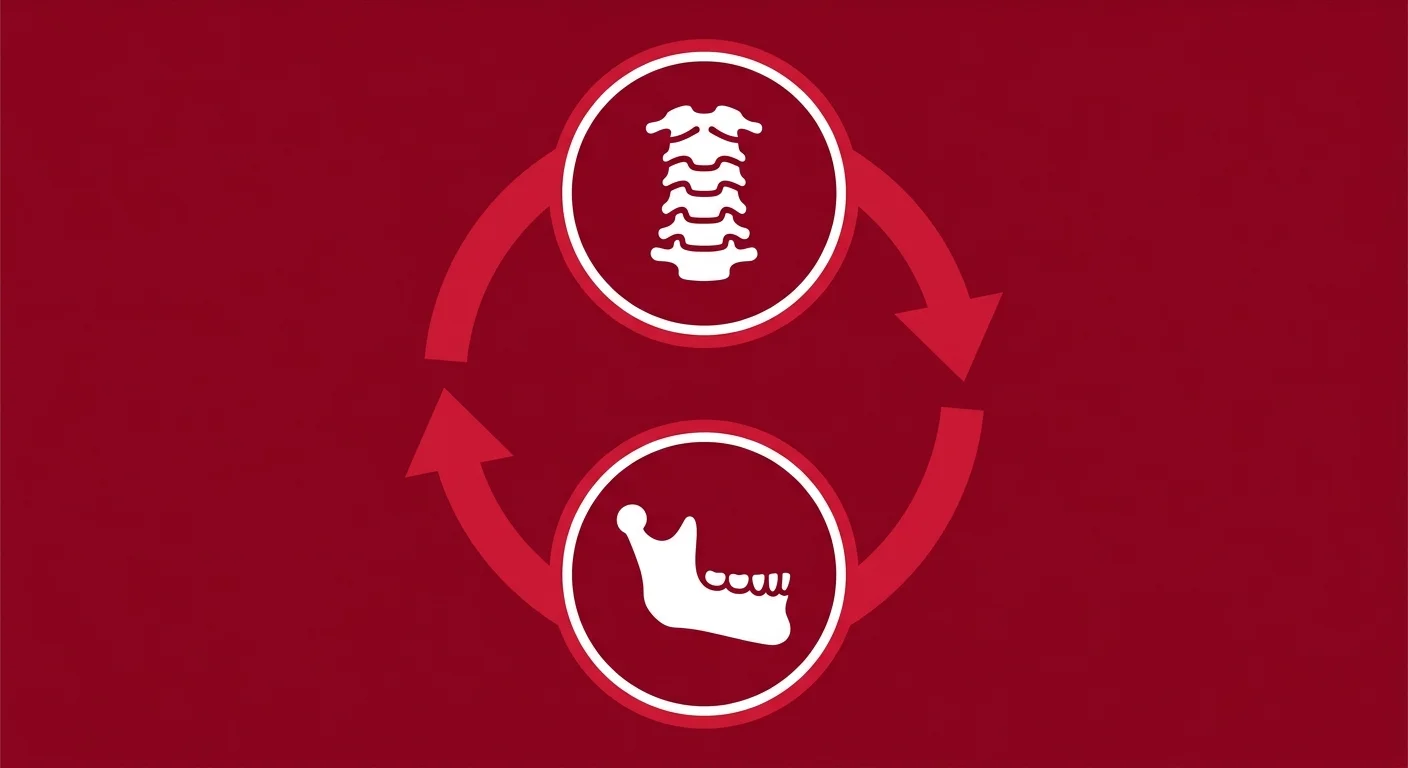
That shared signal pool isn't passive — it runs a live reflex loop. NIH research on trigeminal reflexes confirms it directly: electrical stimulation of the trigeminal system produces measurable reflex responses in the cervical neck muscles. The jaw fires. The neck tightens. That's not a theory. It's a documented physiological reflex, and it runs whether your dentist knows about it or not.
And it runs both directions. Neck tension tightens the jaw. Jaw tension tightens the neck. Neither system waits for permission from the other to respond.
Most dentists never test for this loop. A standard TMJ exam covers joint mechanics, bite alignment, and occlusion. The cervical spine isn't in the field of view — and it isn't in the treatment plan. So the reflex keeps running. Undetected. Untreated. Powerful enough to drive chronic headaches that no nightguard can stop, because the nightguard isn't aimed at the thing generating the signal.
How Neck Tension Directly Increases Jaw Muscle Tone
Here's what that reflex means in the treatment room. A restricted upper cervical joint doesn't just cause neck pain. It generates a continuous nociceptive input into the shared brainstem signal pool — and at the level of the trigeminocervical complex, that input is indistinguishable from jaw input. The jaw muscles receive it as a command. And they respond the only way they know how: they brace.
The masticatory muscles — the ones that close and hold the jaw — get chronically recruited in response to that input. They don't relax, because the signal telling them to tense never stops arriving. The neck is the generator. The jaw is where the current lands.
That's the mechanism the circuit-breaker image was built to describe. The breaker trips in the neck. The fault travels the shared wire. The jaw muscles grind, brace, and ache — because the input driving them is still live. Until that source signal is interrupted, the jaw has no pathway to rest.
Why Most TMJ Treatment Stops at the Wrong End of the Wire
Standard dental occlusal splints protect teeth. That's the actual clinical purpose — buffering the physical damage of bruxism. What they don't do is interrupt the neural signal driving the bruxism in the first place. That distinction matters more than most patients realize.
So the splint sits between the teeth while the reflex loop runs underneath it. Patients wear the guard faithfully. The headaches keep returning. The jaw keeps aching in the morning. The dentist recommends continued use. And the neck — the actual source of the signal — goes unexamined, every time.
The debate over chiropractic adjustments versus nightguards isn't really about competing treatment philosophies. It's about which end of the wire you're treating. Addressing the jaw end manages symptoms. Addressing the neck end goes to the source of the signal. And going to the source is the only move that actually resets the breaker.
The Patients Who Keep Getting Nightguards That Don't Work
There's a recognizable pattern among patients who've spent months — sometimes years — in dental-only TMJ management. They've cycled through multiple nightguards. Different thicknesses. Different materials. Custom-fitted and over-the-counter. Each one helps briefly. Then stops mattering. The jaw pain returns. The headaches come back. And somewhere along the way, the dentist calls it non-compliance — or stress.
It isn't non-compliance. It's the wrong address. The nightguard is doing exactly what it was designed to do — protecting tooth surfaces. But the neural signal driving the clenching and the referred headache isn't coming from the bite. It's coming from a cervical spine nobody has examined. The splint can't resolve what it was never built to reach.
These patients describe their pain the same way. Not acute — exhausting. A chronic background tension in the jaw, temples, and base of the skull that never fully lifts. That description fits the reflex loop exactly. It's not a sharp structural failure. It's a continuous signal running from a restricted upper cervical joint into a brainstem junction that doesn't distinguish neck input from jaw input. The signal keeps arriving. The pain keeps showing up. And the nightguard, sitting at the wrong end of the wire, keeps not being enough.
| Treatment Approach | What It Targets | What It Misses | Typical Outcome for Cervical-Driven TMJ |
|---|---|---|---|
| Dental nightguard / occlusal splint | Tooth surfaces and bite mechanics | The cervical-neurological reflex loop driving the clenching signal | Tooth damage buffered but jaw tension, morning aching, and TMJ headaches continue unchanged |
| Occlusal adjustment / bite equilibration | Bite contact points and jaw alignment | Upper cervical joint restrictions sending distorted proprioceptive input into the trigeminal nuclei | Temporary relief possible; chronic headache pattern persists because the brainstem signal source is untreated |
| Jaw physical therapy (jaw-only protocol) | Masticatory muscle tension and joint range of motion | Bidirectional trigemino-cervical reflex keeping jaw muscles in a chronic bracing state | Muscles release temporarily; resting tone returns as long as the neck is still generating the input signal |
| Upper cervical chiropractic adjustment | C1–C3 joint restrictions feeding nociceptive input into the shared brainstem signal pool | Nothing — this approach addresses the generator, not the symptom end | Jaw muscle tension drops, bite force normalizes, and referred TMJ headaches resolve because the source signal is interrupted |
| Combined dental and upper cervical care | Both the structural jaw mechanics and the cervical neurological driver | Neither component in isolation — both ends of the circuit are addressed | Best clinical outcome; protective dental work is maintained while the reflex loop is resolved at its source |
What Upper Cervical Dysfunction Looks Like in a TMJ Patient
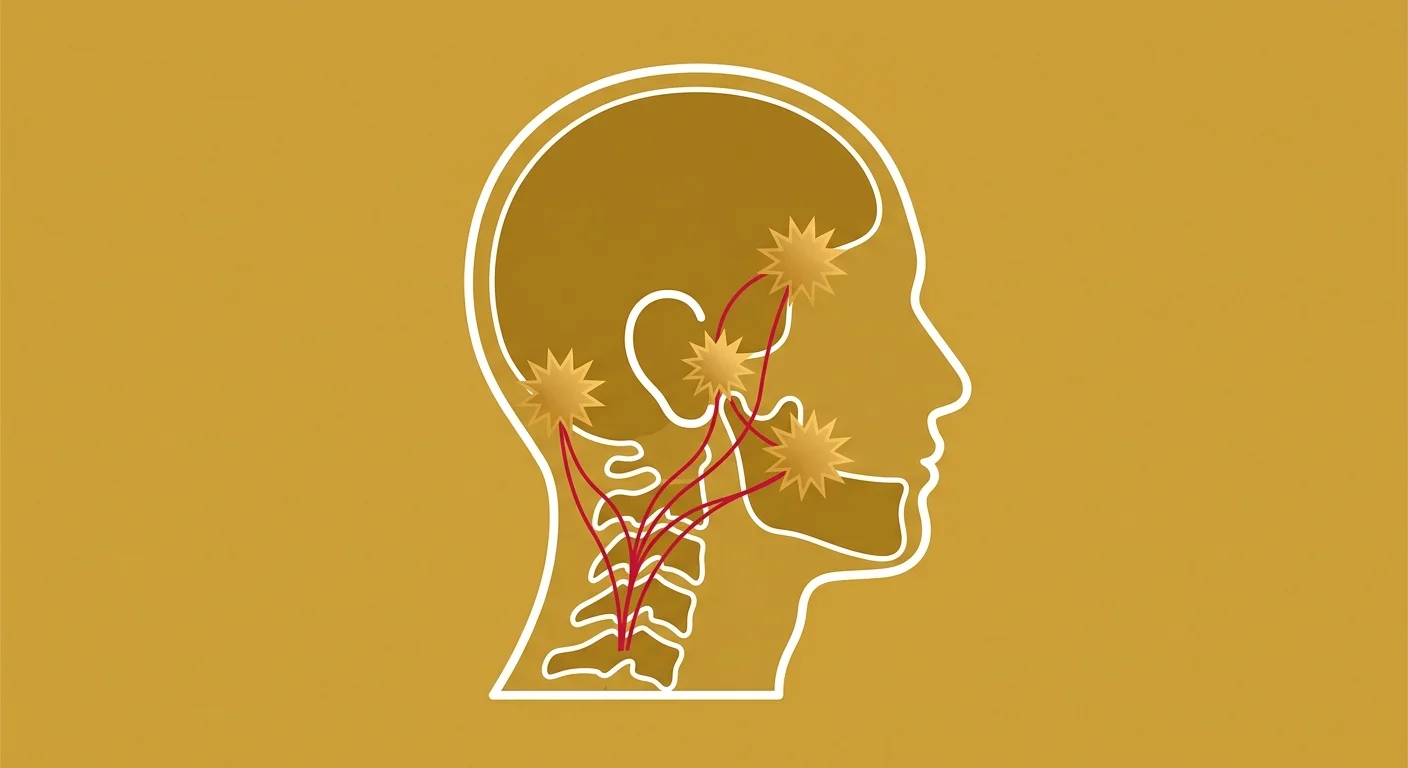
Upper cervical dysfunction doesn't show up as neck pain. That's the whole reason patients spend years in dental offices — and the actual source never gets touched.
The C1, C2, and C3 joints sit right at the brainstem's doorstep. Restrict or misalign them and you don't necessarily get a stiff neck. You get a distorted proprioceptive signal fed directly into the trigeminal sensory nuclei — altering jaw muscle tone in real time. The presentation looks like a jaw problem. The source is in the neck.
Approximately 70% of patients diagnosed with temporomandibular disorders also show clinical cervical spine dysfunction. Most of them were never told that. They got a nightguard, a recommendation to manage stress, and a referral back to their dentist. The neck never entered the conversation. And the headaches never fully left.
The Symptom Cluster That Points to the Neck, Not the Joint
There's a recognizable cluster in patients whose TMJ headaches are being driven by the cervical spine. It doesn't fit a clean dental diagnosis — which is exactly why it keeps getting missed.
- Jaw tension that's consistently worse in the morning — not better after rest
- Temple headaches that track along the same side as neck stiffness
- Ear pressure or fullness with no sign of infection
- Clicking or grinding that worsens during sustained posture — desk work, driving, long phone calls
- A background ache at the base of the skull that connects forward to the jaw
What clinical studies on upper cervical mobilization confirm is that addressing this pattern at the cervical level produces measurable results. NIH clinical evidence documents up to a 54% reduction in active TMJ pain index scores when therapy targets the cervical spine rather than the jaw alone. That's not a marginal effect. It's the difference between resetting the breaker and replacing the lightbulb.
Who This Is Not For
Here's the thing — this approach isn't for everyone. Saying that directly is more useful than dancing around it.
If you need a provider who'll replicate your previous dentist's or chiropractor's exact protocol — this isn't the right fit. The assessment drives the care plan here. Not your prior treatment history. If you've walked in with a list of what worked before and need it duplicated before an evaluation is finished, that's a mismatch. A different result starts with letting the clinical findings lead.
The patients who get the most from cervical-focused TMJ care have one thing in common — dental management alone didn't resolve their headaches. They're ready to follow a clinical lead instead of a familiar routine. They're not looking for the cheapest option or a single-visit answer. They want to know what's actually driving their symptoms. That's what this kind of assessment is built to find out.
| Symptom | Dental-First Interpretation | Cervical Interpretation | Clinical Significance |
|---|---|---|---|
| Morning jaw tension and soreness | Nocturnal bruxism — patient is clenching or grinding during sleep; nightguard recommended | Continuous nociceptive input from restricted C1-C3 joints keeps masticatory muscles in a braced state through the night | If the cervical signal is the driver, the nightguard protects tooth surfaces but cannot stop the muscular recruitment causing the soreness |
| Temple headaches on one side | Referred pain from jaw joint inflammation or myofascial trigger points in the masseter | Unilateral upper cervical joint restriction generating referred pain along trigeminal distribution on the same side | Unilateral presentation that tracks with neck stiffness is a key indicator that the cervical spine — not the joint itself — is the pain source |
| Ear pressure or fullness without infection | TMJ capsule inflammation impinging on the auriculotemporal nerve; bite adjustment recommended | Distorted proprioceptive signaling from C1-C2 misalignment referring into the ear canal region via shared trigeminal pathways | Ear symptoms that persist after dental treatment and resolve only with cervical work are a strong sign the source is the upper neck, not the joint capsule |
| Jaw clicking and grinding that worsens with sustained posture | Internal joint derangement — disc displacement aggravated by occlusal imbalance | Postural cervical load on C1-C3 facet joints alters the proprioceptive feedback loop, increasing masticatory muscle tone and joint compression during sustained neck flexion or extension | Symptoms that worsen during desk work, driving, or phone use point to a postural cervical trigger — not a structural disc problem — as the primary driver |
| Chronic background tension at the jaw, temples, and base of skull | Stress-related myofascial pain; patient counseled on relaxation and continued nightguard use | A continuous low-grade signal from a restricted upper cervical joint feeding into the trigeminocervical complex — never fully switching off, never fully resolved by surface management | Patients describe this as exhausting rather than acute; it fits the reflex-loop pattern exactly and rarely responds to dental management alone |
Frequently Asked Questions
These are the questions that don't get clean answers at the dentist's office.
The patients asking them have worn the nightguard. Done the bite adjustments. Paid for the appliance. And still wake up with the same headache. When the standard explanation keeps failing, these are the questions that surface. They're worth answering properly.
What follows addresses the mechanism most providers skip, why dental appliances fall short of it, and how to recognize the signs that point back to the neck.
If you've been asking these questions and getting referred back to your dentist — that pattern ends here.
What is the trigeminocervical complex, and how does it connect my neck to my jaw?
It's the brainstem junction where the neck and the jaw share the same neural wiring. The C1, C2, and C3 spinal nerves converge onto the exact same second-order neurons as the trigeminal nerve — the nerve that runs jaw sensation and muscle control. That's not proximity. That's shared circuitry.
The brain receives signals from both regions at the same relay point. It can't always distinguish which one sent the input. When the upper cervical spine is restricted, it floods that shared relay with pain signals. The jaw reads them as a command to brace and tense.
The connection isn't a working theory. It's anatomy. And it's why treating the jaw without ever evaluating the neck leaves the actual source completely off the table.
Why doesn't my nightguard stop my chronic TMJ headaches?
Because it's treating the wrong end of the problem.
A nightguard protects tooth surfaces from the physical damage of grinding. That's its actual clinical purpose — and it does that job. What it doesn't do is interrupt the neural signal driving the grinding in the first place.
That signal originates in the upper cervical spine. It travels through the trigeminocervical complex. It arrives at the jaw muscles as a continuous command to brace. The splint sits between the teeth while the reflex loop runs underneath it.
Approximately 70% of patients with temporomandibular disorders also present with cervical spine dysfunction. The neck is involved in the majority of cases. The nightguard isn't failing. It was never built to reach the source.
Can an upper cervical misalignment cause ear pain and jaw clicking?
Yes — and it's far more common than most patients are told.
The C1, C2, and C3 facet joints sit at the brainstem's doorstep. When they're restricted or misaligned, they generate proprioceptive signals that feed directly into trigeminal sensory nuclei — the same nuclei that process sensation from the jaw, the ear, and the face.
Ear pressure without infection. Jaw clicking that worsens with sustained posture. Facial tension that tracks along one side. These don't fit a clean dental diagnosis. They fit a cervical spine that's altering jaw muscle tone from the inside out.
Most patients who present with this symptom cluster have been told it's stress or a bite problem. The neck was never evaluated. That's not a minor oversight — that's missing the source.
How do chiropractic adjustments in the neck resolve TMJ pain?
By interrupting the signal at its source — not managing its effects at the jaw.
The C1, C2, and C3 joints send proprioceptive signals directly into the trigeminal sensory nuclei. When those joints are restricted, the signal is distorted. The jaw muscles receive a continuous input telling them to brace. That's not the jaw malfunctioning. That's the jaw doing exactly what it's been told.
A targeted cervical chiropractic adjustment restores normal joint mechanics. That changes the proprioceptive input reaching the brainstem relay. The jaw muscles stop receiving the tension command — not because anything was done to the jaw, but because the source of the command was corrected.
Research documents up to a 54% reduction in active TMJ pain index scores when therapy targets the cervical spine rather than the jaw in isolation. That's what resetting the source produces. Downstream function restores because the fault is finally addressed where it actually lives.
What are the signs that my TMJ headache is actually coming from my neck?
The clearest sign: dental treatment isn't moving the needle the way a purely dental problem should.
Jaw tension that's worst in the morning. Temple headaches on the same side as neck stiffness. Ear pressure without infection. Clicking or grinding that worsens during desk work, driving, or extended screen time. That pattern fits the proprioceptive feedback loop running from C1, C2, and C3 facet joints into the trigeminal nuclei — not a structural bite problem.
Here's the other signal: the pain is more exhausting than acute. It's a chronic background tension in the jaw, temples, and base of the skull that never fully lifts. Not a sharp flare that resolves. That description fits a continuous neural signal from a restricted cervical joint.
Approximately 70% of patients diagnosed with temporomandibular disorders also present with cervical spine dysfunction. If your TMJ headaches haven't responded to dental management, the neck is what hasn't been evaluated. That's where the answer is.
The Breaker That Keeps Tripping
The breaker keeps tripping because nobody's going to the panel.
That's the whole problem, right there. The trigeminocervical complex is the junction box — the place where the neck and the jaw share the same wiring. When a restricted upper cervical joint trips that breaker, the fault doesn't stay in the neck. It travels the shared wire and surfaces as jaw tension, temple pressure, and a headache that returns every time, no matter how faithfully the nightguard is worn.
Cervical-directed care doesn't add another layer to the treatment stack. It goes to the panel.
When therapy targets the cervical spine instead of the jaw in isolation, the results are documented: up to a 54% reduction in active TMJ pain index scores. That's not a marginal win. That's what happens when you reset the breaker instead of swapping out the lightbulb. The fault at the source gets addressed. Downstream function restores. And the jaw stops receiving a pain signal it was never supposed to be carrying.
If your jaw pain keeps returning after every dental intervention, the answer isn't a better nightguard.
At Touch of Wellness Chiropractic, TMJ headaches get assessed from the cervical spine first — because that's where the breaker is. That's where the reset happens. And until someone goes to the panel, the jaw has no pathway to rest. The neck is where it starts.
The dental visits aren't wrong. They're just incomplete. If the headaches keep coming back, the neck is the part of the system nobody has touched yet. That's where an assessment at Touch of Wellness Chiropractic begins.
Copyright Touch of Wellness Chiropractic 2026
1101 W Jackson St, Suite A Morton, IL 61550
Web Design by iTech Valet