
Neither laser is universally more effective; each serves a different purpose based on power output and biological interaction. Class 4 lasers deliver higher power, which can shorten treatment time and generate mild therapeutic heat within tissue. Class 3B lasers deliver lower power in a purely photochemical, non-thermal interaction that stimulates cellular repair without producing heat.
The distinction is regulatory as well as clinical. The Food and Drug Administration classifies lasers by their potential for harm, and higher power output places Class 4 devices in a category that carries greater risk of thermal tissue effects if dosing is not carefully controlled. Class 3B lasers operate below that threshold, which is why their effect on tissue is understood as a chemical signal to cells rather than a heat-based response.
At the cellular level, both classes rely on photobiomodulation, the process by which specific wavelengths of light are absorbed by structures inside cells and trigger changes that support tissue repair and reduce inflammation. This process depends on delivering a precise amount of light energy to tissue, not simply the largest amount possible. Research on dose-response in photobiomodulation shows that increasing power beyond an optimal range does not produce proportionally better outcomes and can instead reduce or reverse the desired cellular response.
Effectiveness, therefore, is best measured by whether the delivered dose matches what the tissue needs, not by which device produces the highest wattage. A treatment approach built around precise, controlled dosing addresses the underlying cellular mechanism directly, while an approach built around maximizing power risks introducing thermal effects the cellular process does not require.
What Separates a Class 3B Cold Laser From a Class 4 System
Classification comes first, before any conversation about outcomes. Understanding whether a device is Class 3B or Class 4 determines what that laser can actually do to tissue, and what it can do to a patient sitting under it.
The debate between the two often gets framed as a trade-off among power, treatment time, and thermal effect. That framing is accurate, but it skips the step that matters most: the number on the label is a regulatory boundary, not a marketing claim.
| Laser Class | Power Output Range | Typical Marketing Claim | Regulatory Category |
|---|---|---|---|
| Class 3B Laser | Lower power output, operating below the thermal threshold | Positioned around precision and cellular stimulation without heat | Regulated as a lower-risk device category with fewer restrictions on use |
| Class 4 Laser | Higher power output, operating above the thermal threshold | Positioned around speed and deeper perceived intensity | Regulated as a higher-risk device category requiring stricter safety controls |
The Power Threshold That Defines Each Class
Power output is the line the Food and Drug Administration draws between Class 3B and Class 4. Below it, light works on cells chemically. Above it, that same light starts throwing off heat as a byproduct.
That threshold is not arbitrary. It reflects the point where added wattage stops behaving like a cellular signal and starts behaving like an energy source capable of altering tissue temperature.
Why the Label on the Device Matters More Than Marketing Claims
A device's class tells you what it is legally permitted to deliver, not what a brochure says it feels like. A patient can read more about the mechanism behind this in the complete cold laser therapy overview, where the cellular science is laid out in full.
Marketing language tends to sell speed. Classification governs safety and dose. Treating photobiomodulation like a prescription measured in a precise amount, rather than a bottle judged by how fast it empties, keeps the focus where it belongs.
Where the FDA Draws the Safety Line
The Food and Drug Administration does not classify lasers by brand or marketing claim. It classifies them by hazard.
That single fact explains why a Class 4 device and a Class 3B device sit on opposite sides of the same regulatory line.
The Hazard Profile Assigned to Higher-Power Devices
Higher power carries a documented hazard profile. Contextualised to FDA Class IIIb lasers only, that profile does not include the same risk category assigned to Class 4 devices.
Research published through the FDA found Class IV lasers present immediate skin hazard and eye hazard from exposure to either the direct or reflected beam and may also present a fire hazard.
That distinction is not a technicality. It is the reason operators of higher-power devices follow stricter safety protocols than a Class 3B treatment requires.
Skin exposure, eye exposure, and fire risk are not theoretical concerns at Class 4 power levels. They are the specific reasons the FDA places tighter controls on those devices.
A Class 3B laser does not carry that same hazard classification, because its power output stays below the threshold where those risks apply.
What Required Safety Controls Look Like in Practice
In practice, that hazard profile shapes the room a Class 4 laser is used in. Protective eyewear, controlled beam paths, and trained operators are not optional extras.
A reader can compare wavelength behavior further in Than Consumer Red Light Panels, which covers penetration depth in more depth.
A Class 3B treatment carries a simpler safety burden, consistent with its lower place on the FDA's hazard scale.
How Wavelength, Not Wattage, Decides How Deep Light Travels
Power output tells you how much energy leaves the device. It does not tell you where that light ends up inside the body. Wavelength decides depth, and that single distinction changes how each laser class should be evaluated.
| Wavelength | Power Density | Measured Penetration Depth |
|---|---|---|
| 808 nm | 1 mW/cm² | 3.4 cm in bovine tissue, the deeper of the two measured wavelengths |
| 980 nm | 1 mW/cm² | 2.2 cm in bovine tissue, a shallower reach at the same power density |
| Higher wattage rating alone | Not held constant across wavelengths | Not a reliable predictor of depth on its own, since wavelength governs how far light travels regardless of device class |
Comparing Penetration Depth Across Wavelengths
Bovine tissue testing shows the gap clearly. At a power density of 1 mW/cm², 808 nm wavelength light reached a depth of 3.4 cm, while 980 nm light reached only 2.2 cm. PubMed Central reports 808 nm wavelength light penetrates to 3.4 cm depth in bovine tissue at 1 mW/cm² power density, compared to 2.2 cm for 980 nm light — a laboratory finding rather than a study in people. A laser's wattage rating says nothing about which of those two outcomes it produces.
Why Deeper Isn't Automatically Better for Every Target Tissue
Deeper is not automatically the goal. A surface-level injury needs light concentrated near the skin, not driven past the target tissue. Matching wavelength to depth matters more than chasing maximum range, the same logic behind Post-Adjustment Healing and Blood Flow, where circulation responds to targeted delivery rather than raw reach.
Why More Watts Doesn't Mean More Healing
Higher power gets marketed as the better metric. It rarely is.
Wattage tells you how fast a dose arrives, not whether the tissue can use it. That gap is where the overdose problem lives.
The Overdose Problem Nobody Puts on the Spec Sheet
A dose has a ceiling, and crossing it does not add benefit. It creates heat where the cell only wanted a chemical signal.
Research published through OSHA found thermal damage from high-intensity lasers is generally associated with exposure times greater than 10 microseconds and wavelengths in the range from near ultraviolet to far infrared. That threshold is the line between photobiomodulation and a burn. A nervous system focused chiropractic treatment session stays deliberately on the correct side of it.
What Happens Inside the Cell When Photobiomodulation Works
Classification and wavelength tell you what a laser can reach. Neither tells you what happens once the light gets inside a cell. That answer lives in the mitochondria, not on a spec sheet.
The Mitochondrial Chain Reaction Light Sets Off
Photons from red and near-infrared light are absorbed by mitochondrial cytochrome C oxidase inside the cell. That activation modulates ATP, generates reactive oxygen species, and alters intracellular calcium levels. Those shifts switch on signaling pathways tied to cellular proliferation, migration, and differentiation. PubMed reports activation of mitochondrial cytochrome C oxidase by red and near-infrared light photons leads to modulation of ATP, generation of reactive oxygen species, and alterations in intracellular calcium levels, which promote the activation of signaling pathways that contribute to cellular proliferation, migration, and differentiation — one expert assessment rather than a study finding. That chain reaction is the actual mechanism behind photobiomodulation, regardless of which laser class delivered the light.
How Thermal Load Undermines a Photochemical Reaction
Thermal load does not add to that chain reaction. It disrupts it. Heat pushed past a cell's tolerance interferes with the same mitochondrial signaling the photochemical reaction depends on. A precise dose supports that chemistry. Excess wattage risks overriding it, the same way a prescription measured in a precise amount does more than a bottle judged by how fast it empties.
How a Photobiomodulation Session Is Actually Structured
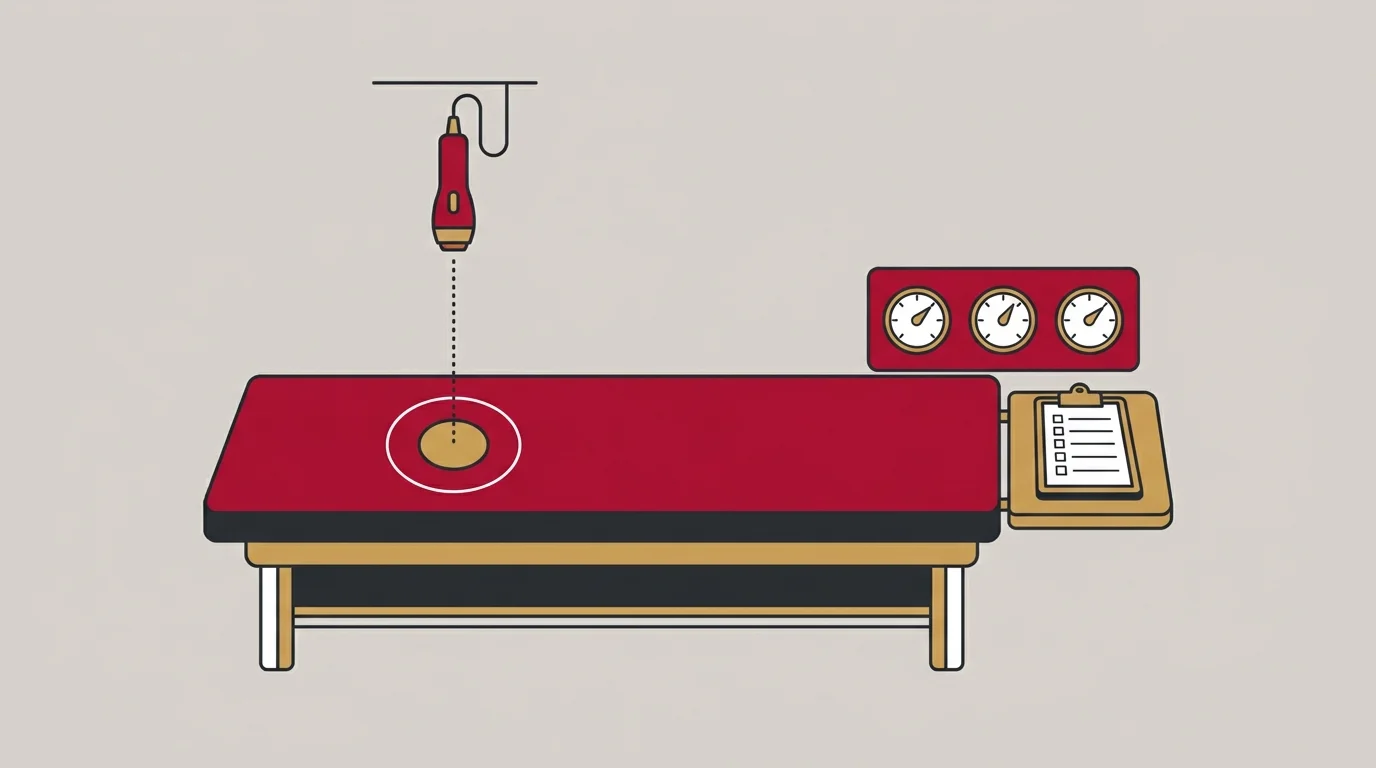
A session isn't improvised. Power, time, and distance all get set before the laser ever touches skin, because each one changes the dose that reaches the tissue underneath.
| Session Parameter | What It Controls | Why It Is Documented |
|---|---|---|
| Power Output | The ceiling on how much energy can reach tissue in a given moment | Radiant power is a required parameter in FDA premarket submissions, because it defines the upper limit of the dose a device can deliver |
| Wavelength | How deep the light travels before it reaches its target | Wavelength determines whether a treatment plan is even physically capable of reaching the tissue it is meant to affect |
| Exposure Time | How long tissue is held under the beam, shaping total energy delivered | Documented exposure time separates a photochemical dose from the thermal exposure window regulators track |
| Distance From Tissue | How concentrated the delivered light is once it reaches the skin | Distance is recorded because irradiance changes with proximity, and irradiance is one of the parameters FDA guidance requires a device description to state |
| Treatment Area | Which structures receive the dose and which are deliberately spared | Documenting the treatment area keeps the session tied to the specific tissue the dose was calculated for, not a generalized pass over the body |
Setting Power, Time and Distance for a Precise Dose
Power sets the ceiling on a session. Time and distance decide how much of that power actually lands. A Class 3B laser held at a measured distance for a set duration delivers a dose built to trigger cellular repair, not to maximize heat.
Reading the Submission Requirements Behind a Cleared Device
Regulatory paperwork confirms what dosing actually requires. Contextualised to class II PBM devices in 510(k) submissions, FDA guidance documents identify radiant power and irradiance as required parameters for device description. Research published through the FDA's photobiomodulation device guidance found radiant power and irradiance are required parameters for device description in photobiomodulation premarket submissions. Those parameters exist because dose, not brand, determines outcome.
Frequently Asked Questions
A handful of questions come up in nearly every conversation about laser class. Here are straight answers to the ones that matter most.
Is a Class 4 laser more painful than a Class 3B laser during treatment?
Neither device causes pain in a typical Chiropractic adjustment session. A Class 4 laser does throw off more heat as power climbs. A Class 3B session usually stays at a mild, gentle warmth.
If Class 4 lasers are more powerful, does that mean they are always better?
No. Higher power moves a dose faster, but cellular repair depends on a precise amount reaching the tissue, not on raw wattage. Past a certain threshold, added power risks working against the same repair process it is meant to support.
How long does a typical chiropractic laser therapy session take with each type of laser?
A Class 4 session generally runs shorter because higher power delivers a dose more quickly. A Class 3B session takes longer, since the same dose is delivered at a lower, purely photochemical power level.
Are there any conditions where a Class 3B laser is more effective than a Class 4?
Yes. Surface-level or sensitive tissue often responds better to a Class 3B laser, since its lower power keeps the interaction chemical rather than introducing thermal effects the area does not need.
What are the main safety risks associated with Class 4 lasers that aren't present with Class 3B?
Class 4 devices carry a documented hazard profile that Class 3B lasers do not share at the same level. Skin exposure, eye exposure, and fire risk all sit meaningfully higher once power crosses into Class 4 territory.
Can either type of laser therapy be used over metal implants or surgical hardware?
Either class can generally be used near metal implants or surgical hardware, since photobiomodulation works at the cellular level rather than by pushing heat into metal. A case involving surgical hardware still deserves a direct conversation before treatment begins.
Where This Leaves the Dosing Debate
This debate was never really about power. It was about whether a laser hands a cell the exact amount of light it can use — a dose measured out like a prescription, not a bottle judged by how fast it empties.
Class 4 devices move that dose faster. Class 3B devices keep the reaction purely photochemical, without pushing tissue toward the thermal threshold that undoes the same cellular signaling it is meant to trigger. Precision, not speed, is what the mitochondria actually respond to.
That is the position this practice holds, and it is not a neutral one. If the dosing question sounds like something worth asking about your own care, schedule a visit with Touch of Wellness Chiropractic.