
(309) 321-8412 | 1101 W Jackson St, Suite A, Morton, IL 61550
(309) 321-8412 | 1101 W Jackson St, Suite A, Morton, IL 61550
Can Specialized Chiropractic Care Actually Heal Damaged Nerves? The Biological Path to Repair
Yes — specialized chiropractic care can facilitate actual nerve healing. Not by reaching into the tissue and rebuilding it directly. By removing the structural interference that’s preventing your body from doing that job on its own.
That distinction matters. The body has a documented capacity to regenerate peripheral nerve fibers. It does this through a process called neuroplasticity — the nervous system’s ability to adapt, reorganize, and repair when the right conditions exist. The critical word is conditions. When a nerve is compressed by a spinal misalignment, it operates under chronic mechanical stress and inflammation. Under those conditions, the repair process is blocked before it begins.
Specialized chiropractic care addresses the source of that blockage. A precise chiropractic adjustment corrects the structural problem. That correction reduces compression and lowers the inflammatory load surrounding the nerve. Once that interference is cleared, the biological environment shifts — and the body’s own healing mechanisms can engage.
This is not the same as managing pain with medication. Pain relief and nerve restoration are not the same outcome. Pharmaceutical intervention reduces what you feel. A clinical chiropractic adjustment changes what’s actually happening to the nerve.
At Touch of Wellness Chiropractic in Morton, IL, nerve healing is treated as a whole-organism biological process — one that requires structural correction, clinical precision, and in many cases, advanced tissue-regeneration modalities like Cold Laser Therapy or Shockwave Therapy. The approach doesn’t start with the symptom. It starts with the cause.
This article covers how that biological process works, what it actually requires, and what realistic nerve restoration looks like when a care plan is built around it — not around a symptom you’ve been told to manage indefinitely.
Last Updated: April 8, 2026
- What Most Providers Miss About Nerve Damage
- The Biology of Nerve Repair — What Has to Happen First
- What Specialized Care Actually Looks Like in Practice
- Why “You’ll Just Have to Live With It” Is the Wrong Answer
- Frequently Asked Questions About Chiropractic Care and Nerve Healing
- Is nerve damage always permanent?
- How does a spinal adjustment help a nerve in my foot?
- Why didn’t my general practitioner suggest chiropractic for my neuropathy?
- What are the signs that my nerves are starting to heal?
- What happens if I stop care as soon as the pain goes away?
- Can Cold Laser Therapy or Shockwave Therapy help with nerve damage?
- How is specialized chiropractic care different from a general chiropractic adjustment?
- The Biological Reality Your Care Plan Needs to Reflect
What Most Providers Miss About Nerve Damage
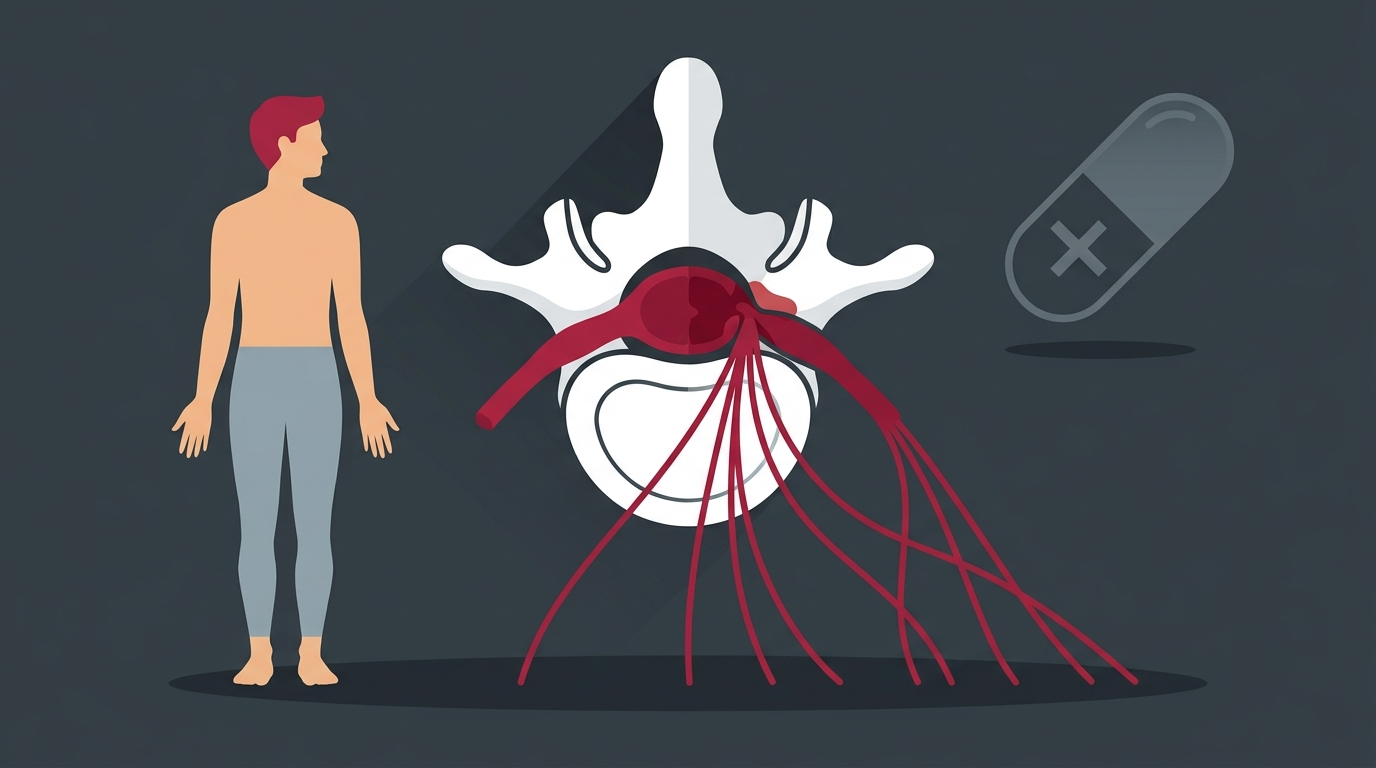
The nerve isn’t the problem. It’s the result of the problem.
Every nerve symptom — the numbness, the burning, the radiating pain — has a source. And the source isn’t in the nerve itself. It’s in the mechanical environment the nerve is operating inside.
Address the environment, and the nerve can repair. Address only the nerve, and you’re chasing the signal instead of correcting what’s generating it.
That’s root-cause chiropractic care in a sentence: get upstream of the problem before you touch the endpoint.
The Difference Between Symptom Management and Functional Restoration
Most people who walk in want one thing. They want the pain to stop.
That’s a reasonable starting point — and it’s not wrong. But “it stopped” and “it healed” are not the same outcome. Medication can produce the first one without ever touching the second.
Pharmaceutical management works at the signal level. It changes how the brain receives pain information — not what’s generating it. The nerve is still compressed. The inflammation is still there. The structural problem is still present. The symptom just gets quieter.
Quiet is not healed.
Functional restoration means the nerve actually repairs. Sensation normalizes. Function returns. The body stops compensating. That requires clearing the interference — not muffling the message.
| Symptom Management | Functional Restoration | |
|---|---|---|
| Goal | Reduce pain signal | Repair nerve tissue and function |
| Primary Method | Pharmaceutical suppression | Structural correction + neuroplasticity |
| Addresses root cause | No | Yes |
| Measurable outcome | Pain scale reduction | Improved sensation, strength, balance |
| Duration of effect | Stops when medication stops | Long-term — structural repair holds |
Why High-Volume, Rushed Adjustments Don’t Produce Nerve Repair
Walk into a high-volume practice with nerve pain. You’ll get a protocol.
It won’t be built from your history or your response to care. It’ll be the sequence that runs every patient — fifteen, twenty, forty people in a day through one provider. The math doesn’t leave room for clinical depth.
That model can handle straightforward musculoskeletal complaints. It’s not engineered for the tracking nerve repair requires.
Healing nerves leave markers at every visit. What changed? What’s improving? What isn’t responding? A care plan that doesn’t integrate those answers isn’t a care plan. It’s a schedule.
The 15-minute door-to-door standard at Touch of Wellness Chiropractic isn’t a speed promise. It’s what individualized clinical care for nerve conditions actually takes — and a commitment not to compromise on that.
Why Medication Can’t Fix a Structural Problem
Gabapentin has one job. Turn down the volume.
It reduces the calcium channel activity that amplifies pain signals in the nervous system. It doesn’t decompress the nerve root. It doesn’t clear the inflammation surrounding the tissue. It doesn’t correct the spinal misalignment that created the problem.
The structural environment stays exactly as it was — the alarm just gets quieter.
Here’s the clinical reality that matters. Nerve fibers have a window for meaningful regeneration. The longer the compression continues, the narrower that window gets. Every month on pharmaceutical management without structural correction is another month the nerve operates in the environment that’s damaging it — with the urgency suppressed enough that nothing changes.
Patients who’ve been on gabapentin for a year often present with more significant functional deficits than those who arrive earlier. Not because the medication made things worse directly. Because it made the situation feel manageable while the actual problem progressed.
Clinical research on neuropathic pain consistently points toward multi-modal, patient-centered approaches as the path to durable relief — not single-modality pharmaceutical management. That’s not a chiropractic opinion. That’s the clinical literature running into the same ceiling repeatedly.
The work at Touch of Wellness Chiropractic isn’t positioned against your medication. It’s positioned at the level your medication was never designed to reach.
The Biology of Nerve Repair — What Has to Happen First

Nerve healing is a sequence, not a switch.
That framing matters. It moves the question from “can this be fixed?” to “are the right conditions for repair actually in place?” Those are different clinical questions. The second one changes how a care plan gets built.
Neuroplasticity — What It Is and What Blocks It
Your nervous system was designed to repair itself. The problem isn’t capacity. It’s the environment you’re asking it to repair in.
Neuroplasticity — the nervous system’s ability to reorganize, adapt, and regenerate — is a measurable biological process. It shows up in motor control, sensory function, and the recovery trajectory after injury or chronic stress.
It’s not a concept. It’s a mechanism.
It also has requirements. Compression blocks it. Chronic inflammation blocks it. Structural misalignment that keeps loading the nerve root blocks it.
The body’s repair mechanisms can’t run effectively in a hostile environment.
Remove the interference, and the system can do what it was built to do. Research in MDPI’s Brain Sciences journal confirms that chiropractic adjustments measurably alter central nervous system function — with documented improvements in both motor and sensory recovery. The mechanism isn’t complicated. Correct the compression. Reduce the inflammation. Restore clean signal transmission. The system responds.
The Role of BDNF in Nerve Regeneration
One of the ways chiropractic care works at the chemistry level is through BDNF — brain-derived neurotrophic factor.
BDNF is a biomarker critical to nerve cell growth, maintenance, and the brain’s ability to form new neural connections after damage. It’s one of the primary drivers of the repair process at the cellular level — not a side effect, not an abstraction.
Chiropractic care has been shown to modulate BDNF levels, supporting the biological infrastructure neuroplasticity and nerve regeneration depend on. That’s a measurable shift in the chemistry that determines whether repair actually happens.
This is why I treat every nerve case as a whole-system problem. The nerve causing trouble in your foot or your hands isn’t failing in isolation. It’s downstream of a system. And the system is what we’re working on.
Advanced Modalities That Accelerate Cellular Regeneration
Structural correction sets the stage. Advanced modalities can accelerate the repair once the conditions are right.
- Cold Laser Therapy (photobiomodulation) — targets the cellular level directly, increasing ATP production inside damaged nerve cells and giving the tissue the energy it needs to regenerate.
- Shockwave Therapy — delivers acoustic pressure waves to targeted tissue, breaking down fibrous adhesions that restrict or entrap peripheral nerves, increasing local circulation, and triggering growth factor release that drives the repair process.
Both are clinical tools — not comfort measures. And sequencing is everything. Used before the structural source is corrected, they underperform. Used after, when the environment is ready for them, they shorten the timeline in a way adjustment alone can’t.
Dr. Hannah’s Systems Biology Lens
My Zoology degree wasn’t a detour. It was the framework.
Systems biology doesn’t treat a nerve as a wire with a problem at one point. It treats the organism as a whole — every part of the system affecting every other part. The nerve in your foot is embedded in a system that includes your spinal alignment, your circulation, your inflammatory load, and your brain’s ability to manage all of it.
Treating only the foot misses the source upstream. I’ve seen that pattern play out the same way in patient after patient who arrived here after the symptom-first approach ran out of answers. The assessment doesn’t start at the pain site. It starts at the source.
What Specialized Care Actually Looks Like in Practice

Specialized isn’t about the equipment in the room. It’s about what drives the care plan.
The neuropathy care approach at Touch of Wellness Chiropractic isn’t built from a template. It’s built from your clinical picture — what you report, how you respond, and what changes between appointments.
The 15-Minute Clinical Standard Is a Clinical Commitment
Fifteen minutes door-to-door. For nerve cases, that means something specific.
It’s not a speed promise. It’s a focus promise. Every appointment is structured around what’s happening in your case — what’s changed, what hasn’t, and what the clinical picture is telling us about where the plan needs to go next.
A nerve that’s healing leaves markers. A nerve that isn’t leaves different ones. Catching the difference requires attention that a high-volume rotation can’t produce.
Your care plan gets built from what you actually report — not from what a diagnosis code says you should have. If something isn’t producing results after a few visits, it changes. Not repeats. The willingness to stop and reassess is what separates a care plan from a schedule.
| What to Expect | What’s Happening Clinically | Approximate Timeframe |
|---|---|---|
| Initial structural correction phase | Compression reduced, inflammation beginning to decrease | Weeks 1–4 |
| Sensory shift — “waking up” phase | Nerve conduction improving — changed sensation precedes normalization | Weeks 3–8 |
| Functional improvements begin | Strength returning, balance stabilizing, sleep improving | Weeks 6–16 |
| Durable repair consolidation | Structural repair complete, recurrence risk reduced | Weeks 12–24+ |
Results may vary. Individual timelines depend on the extent of nerve involvement, duration of damage, and clinical response.
If You’re Looking for One Adjustment to Fix This — That’s Worth Addressing Directly
Nerve regeneration has a biological timeline. No single adjustment overrides it.
If you’re expecting numbness that’s been building for two years to resolve after one visit — that expectation isn’t going to be met here. Not because we’re withholding anything. Because that’s not how nerve tissue repairs. Building the right conditions for regeneration takes consistent clinical work across time.
There’s also a pattern worth naming directly. Pain eases before repair is complete. The inflammatory load drops, the urgency disappears, and a lot of patients stop care. Three to six months later they’re back at the starting line — or further behind, because incomplete repair cycles make the next round harder.
If you want one adjustment to fix a long-standing nerve problem, this isn’t the practice for that. Knowing that now is more useful than finding out three visits in.
If you’re ready for a structured clinical plan built from your actual presentation — that’s what this practice is built to deliver.
Why “You’ll Just Have to Live With It” Is the Wrong Answer
“You’ll just have to live with it.” That sentence has followed a lot of patients into this office.
It wasn’t said maliciously. The provider ran the standard pathway, hit the end of it, and delivered the most honest answer the framework allowed. That’s not negligence. That’s the ceiling of a system that wasn’t designed to find the source.
When the Standard Medical Pathway Runs Out of Options
Here’s how the standard pathway for nerve pain works. You report the symptom. Imaging gets ordered. A diagnosis gets attached. Pharmaceutical management begins.
When that doesn’t hold — and for a significant number of patients, it doesn’t — the options narrow. More medication. Injections. Surgery if imaging reveals something significant enough to justify it.
What’s absent from that sequence is structural correction before it reaches the surgical level. Chiropractic adjustment isn’t a last resort. It’s a first-line structural intervention that the standard referral pathway consistently skips — and the longer the skip, the harder the recovery.
Real answers are more valuable than comfortable ones. “Nothing can be done” ends the clinical responsibility. It isn’t always accurate.
Dismissed doesn’t mean untreatable. It means the framework used to assess you ran out of options before it found the right one.
If the pharmaceutical loop hasn’t produced results, that’s the specific gap this practice is built to address. For patients whose neuropathy care has hit that ceiling and want to understand why — the answer isn’t complicated, it’s just the wrong framework.
What Realistic Nerve Healing Looks Like — and How to Know It’s Working
Nerve healing doesn’t arrive as a single dramatic shift. It shows up in patterns. Tracking those patterns across visits is part of the clinical work.
- Changed sensation — not eliminated sensation — Healing usually starts with a shift in how the area feels, not the disappearance of feeling. Numbness that was constant starts going intermittent. Tingling changes character.
- A temporary “waking up” phase — Some patients notice increased sensitivity before things normalize. The nerve is beginning to conduct again. It’s a positive indicator, not a setback.
- Functional improvements before pain fully resolves — Grip strength returns. Balance stabilizes. Coordination comes back. Motor fibers and sensory fibers don’t regenerate at the same rate — function often leads.
- Sleep improving first — Nerve pain tends to peak at night. Sleep quality improving is frequently the earliest whole-body sign that the inflammatory environment is shifting.
These patterns tell the clinical story. For a deeper look at how the full protocol is built to repair the human nervous system, the protocol page covers it in full.
| Healing Indicator | What It Means Clinically | Significance |
|---|---|---|
| Numbness becomes intermittent | Compression reducing, signal stabilizing | Structural correction is holding |
| Tingling shifts in character | Nerve conduction pattern changing | Active neurological shift underway |
| Temporary heightened sensitivity | Nerve “waking up” — active repair phase | Expected and normal — not regression |
| Sleep quality improving | Systemic inflammatory load decreasing | Whole-organism environment shifting |
| Strength and balance returning | Motor nerve fibers regenerating | Functional restoration progressing |
Frequently Asked Questions About Chiropractic Care and Nerve Healing
Is nerve damage always permanent?
No. Peripheral nerves have a significant capacity for regeneration — if the source of structural interference is removed and the biological environment is optimized for repair.
When the cause is never addressed, the damage accumulates. But compression corrected while viable tissue remains creates the conditions for recovery. How much recovery depends on duration and severity — but “permanent” isn’t where this practice starts.
What the Nerve Restoration Protocol at Touch of Wellness Chiropractic does differently is treat nerve healing as a whole-system process — not a series of isolated adjustments. That distinction is what moves the needle on outcomes.
How does a spinal adjustment help a nerve in my foot?
The brain controls everything in your body through your spinal cord and peripheral nerves. When there’s a misalignment in the spine, the signal between the brain and its peripheral targets — including nerves in your foot — gets disrupted.
Inflammation from that misalignment travels through connective tissue and affects how peripheral nerves function well beyond the spine itself.
Correcting the alignment clears the signal pathway and reduces the inflammatory load those nerves are operating in. The foot doesn’t get treated directly. The system that manages the foot does.
Why didn’t my general practitioner suggest chiropractic for my neuropathy?
Standard medical training doesn’t position chiropractic as a primary-line structural intervention for nerve conditions. The default pathway leads to pharmaceutical management — not because it’s the most effective route, but because it aligns with prescribing authority and training protocols.
That’s not a failure of individual GPs. It’s a structural limitation of a siloed system — and the referral gap consistently costs patients time they can’t recover.
Clinical literature on neuropathic pain management increasingly supports multi-modal approaches that go beyond pharmaceutical management alone. Most GPs weren’t trained to recommend structural correction — and the reimbursement system doesn’t incentivize the referral.
What are the signs that my nerves are starting to heal?
Healing typically begins before pain fully resolves. Early indicators are changes in sensation — not the absence of it.
Numbness goes from constant to intermittent. Tingling shifts in quality.
Some patients notice a brief heightened sensitivity — the nerve waking up as conduction improves. That’s a positive sign, not a step backward.
Functional markers follow: grip strength, balance, coordination returning. Sleep quality is often the first systemic indicator that the whole environment is shifting. Tracking these patterns across visits tells us whether the plan is working and where to go next.
What happens if I stop care as soon as the pain goes away?
The pain resolves before the nerve has fully healed — that’s the standard pattern. The inflammatory load drops, the symptom eases, and the urgency disappears.
But the repair isn’t done. The nerve is still in the same mechanical environment that caused the damage. That vulnerability doesn’t disappear because the symptom quieted.
Regression is the typical result — sometimes fast, sometimes over months. And the next round is often harder because the tissue went through a partial repair cycle that wasn’t completed.
The care plan isn’t about visit count. It’s about finishing what the biological process requires.
Can Cold Laser Therapy or Shockwave Therapy help with nerve damage?
Yes — when sequenced correctly as part of a clinical care plan. Cold Laser Therapy (photobiomodulation) directly stimulates cellular repair mechanisms in nerve tissue, increasing the energy available for regeneration.
Shockwave Therapy handles a different piece — breaking down fibrous adhesions that can restrict peripheral nerves, increasing local circulation, and triggering the growth factor release that supports repair.
Neither works as a standalone. Structural correction through chiropractic adjustment comes first. Add the modalities afterward, in the right order, and the timeline shortens in a way neither approach achieves on its own.
How these tools combine to repair the human nervous system is what the full protocol is built around.
How is specialized chiropractic care different from a general chiropractic adjustment?
The difference is diagnostic depth, individualized care plan design, and the willingness to reassess when something isn’t working. A general chiropractic adjustment in a high-volume practice follows a predetermined sequence.
It doesn’t track your specific neurological presentation or build from what previous visits have revealed. Everyone gets the same sequence regardless of their response.
Specialized care starts with a thorough assessment — where the nerve involvement originates, what’s driving it, and what the right clinical sequence actually looks like for your case. The plan adapts when your clinical response changes. The goal is functional restoration, not visit count.
For a direct comparison, see how specialized nerve care differs from a standard adjustment.
The Biological Reality Your Care Plan Needs to Reflect
Nerve healing isn’t a theory. It’s biology. And biology has requirements.
You can’t meet those requirements with a medication that silences the alarm while the structural problem progresses. You can’t meet them with a protocol that runs the same sequence on every patient. And you can’t meet them by telling someone to wait it out and see what happens.
The nervous system runs everything. When it’s structurally compromised, nothing else works right — and you feel that in ways that accumulate into your entire day. Pain. Numbness. Lost function. The slow frustration of being told there’s nothing to be done. What’s needed isn’t a softer version of the same failed approach. It’s getting upstream of the problem and addressing the mechanical environment the nerve is actually operating in.
My Zoology degree gave me a framework for that. The nerve in your foot isn’t a standalone failure. It’s part of a biological system that can be assessed, corrected, and supported in its capacity to repair. Real answers require looking at the whole system. That’s what this practice is built to do.
Nerve pain that’s been managed without resolving is a structural problem wearing a pharmaceutical mask.
If the numbness, burning, or loss of function has followed you through prescriptions, referrals, and “let’s wait and see” conversations — that’s the pattern of a problem that hasn’t been approached from the right level.
An assessment at Touch of Wellness Chiropractic starts with your nervous system as it actually is — not a standard protocol, and not a timeline handed to you before the evaluation is finished. The goal isn’t to get you in. It’s to find out whether the structural source is what’s been missed.
If you’re in Morton, Peoria, or the surrounding central Illinois area, find out what a nerve-focused assessment looks like.
Your nervous system has the capacity to repair. The conditions are what have to be built.
Copyright Touch of Wellness Chiropractic 2026
1101 W Jackson St, Suite A Morton, IL 61550
Web Design by iTech Valet